

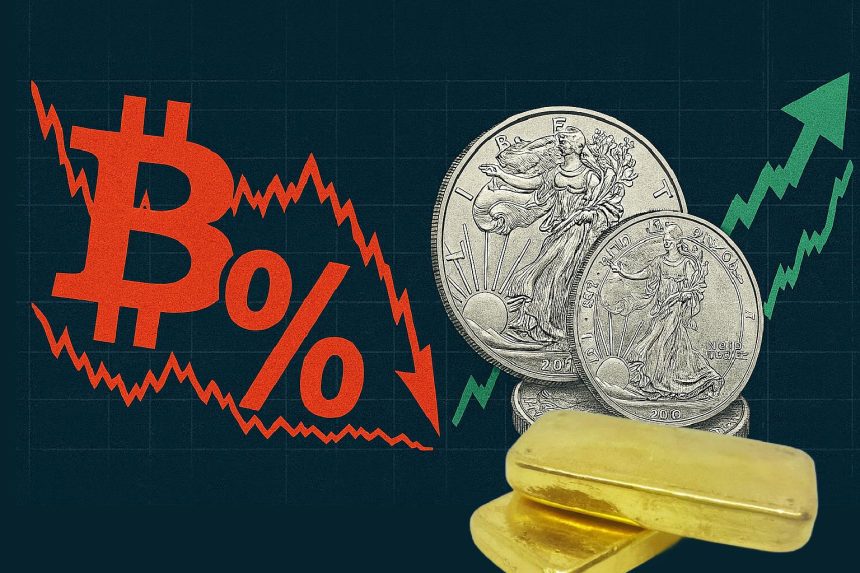
October 2025 has etched itself into financial history, not for the usual triumphs, but for a dramatic and unsettling reversal. As Bitcoin, the poster child of digital innovation, plunged into an unexpected crisis, the ancient beacons of wealth—gold and silver—ascended to unprecedented heights. This isn’t merely a market fluctuation; it’s a profound re-evaluation of where true security lies in an increasingly volatile global economy. The question is, what truly triggered this seismic shift from digital daring to physical refuge?
Bitcoin’s “Uptober” Unravels: A Digital Dream Deferred?
For years, October has been synonymous with optimism for Bitcoin traders, affectionately dubbed “Uptober.” Historically, the cryptocurrency has closed seven of the last ten Octobers in positive territory, often rebounding strongly from September dips. Yet, 2025 has shattered this pattern with brutal efficiency.
From above $126,000, Bitcoin plummeted over 25% to near $100,000 since the month began. This isn’t just a correction; it’s a crisis amplified by surging U.S.-China trade tensions and a mounting wave of fear in global credit markets. Analysts are now sounding alarms, with warnings of a potential slide to $70,000 should macroeconomic conditions further deteriorate. Is this simply a temporary setback, or does it signal a premature end to the 2025 bull cycle, forcing investors to confront the true fragility of digital assets?
Option trading data reveal a stark picture: investors are rushing to buy protection, while liquidity across major exchanges has thinned dramatically. For a market built on narratives of disruption and decentralization, the pain is both psychological and structural. It forces us to ask: can a market so susceptible to external geopolitical and credit shocks truly be considered a safe haven?
Gold’s Enduring Ascent: The Ultimate Hedge Reasserts Itself
As Bitcoin stumbled, gold didn’t just rally; it surged to historic highs. Futures peaked above $4,250 per ounce on October 16, with spot prices hovering near $4,240. This isn’t a modest gain; gold has erupted by nearly 60% since January, marking its strongest annual performance since the tumultuous year of 1979.
What fuels this radiant rally? A confluence of factors, including mounting expectations of Federal Reserve rate cuts, persistent inflationary pressures, and escalating geopolitical strain. HSBC has significantly raised its 2025 average forecast for gold to $3,355, predicting further gains in 2026 as safe-haven demand intensifies. Central banks, too, are playing a pivotal role, diversifying their reserves away from the dollar, while ETF inflows have reached multi-year highs with over 634 tons added year-to-date.
Analysts at ANZ and Trading Economics suggest this momentum will carry through the year-end, potentially pushing gold toward $4,400 if global conditions continue to sour. Does this remarkable performance simply reflect fear, or is it a deeper re-affirmation of gold’s intrinsic value in times of systemic uncertainty?
Silver’s Strategic Surge: More Than Just Gold’s Little Brother
If gold is the bastion of wealth preservation, silver, often overlooked, is proving itself a formidable symbol of resilience. Silver prices have soared past $52.80 per ounce, astonishingly up roughly 25% in a single month and a staggering 66% year-over-year. This accelerated growth highlights its dual appeal: its vital industrial applications and its traditional role as an accessible hedge against crisis.
Supply bottlenecks and record demand from Asia have compounded the upward pressure. Experts note that silver’s inherent volatility, far from being a deterrent, may actually amplify its strategic value within a diversified, multi-asset hedge portfolio. While gold often reflects institutional movements, silver has emerged as the retail investor’s entry point into the safety trade—tangible, liquid, and increasingly scarce. In an era where trust in traditional and digital financial systems wavers, how much further can silver’s unique blend of utility and haven potential propel its value?
The Cracks in Credit: A Deeper Undercurrent of Instability
Underpinning these dramatic market shifts is a growing sense of unease within the credit markets. Global financial institutions are sounding alarms, pointing to significant cracks in the colossal $5 trillion private credit market. Goldman Sachs and other major banks warn of rising defaults, coupled with opaque lending channels, potentially triggering a broader liquidity crunch that could reverberate throughout the financial system.
The wobble in U.S. regional bank shares, rekindled investor anxiety, and widening credit spreads all signal stress that could easily bleed into equities and high-yield bonds. This isn’t an isolated problem; it’s a systemic vulnerability. Does the fragility of the credit market reveal the ultimate driver behind the flight to tangible assets, exposing a fundamental mistrust in the very fabric of modern finance?
A Flight to Tangible Trust: The Enduring Power of Physical Assets
This October is more than just another month in the financial calendar; it’s a pivotal turning point. Bitcoin’s swift decline from its heralded status as “digital gold” to a sensitive barometer of market fear underscores a persistent, perhaps immutable, need for tangible assets when uncertainty reaches critical mass.
Gold’s glittering ascent past $4,200 and silver’s extraordinary surge are not isolated incidents born of speculative frenzy. They represent a fundamental, deliberate rotation of capital from perceived risk to undeniable refuge. As digital markets grapple with volatility and recalibrate their expectations, precious metals are asserting themselves as the undeniable winners of the 2025 financial storm.
In a month once synonymous with digital optimism, October has become the stage for an age-old truth to re-emerge: when credit cracks and confidence falters, capital invariably seeks the unwavering security of something it can truly hold. As investors navigate this complex terrain, are we witnessing a temporary market correction, or a profound, irreversible shift in the very definition of security and value?




![Clean Code: Functions and Error Handling in Go: From Chaos to Clarity [Part 1]](https://techtonic.xpansieve.com.ng/wp-content/uploads/2025/10/Clean-Code-Functions-and-Error-Handling-in-Go-From-Chaos-150x150.png)


