By using this site, you agree to the Privacy Policy and Terms of Use.
Accept
Sign In
TechTonicTechTonicTechTonic
Notification Show More
Font ResizerAa
  • Home Technology
    • Home 2Hot
    • Home 3
    • Home 4
    • Home 5New
  • Technology
    Technology
    Modern technology has become a total phenomenon for civilization, the defining force of a new social order in which efficiency is no longer an option…
    Show More
    Top News
    Apple Jul Announcement: What a Refresh for Macbook
    Sponsored by
    Sponsored by
    Advantages and Disadvantages of Having Smartphone
    December 8, 2021
    Top 10 Best Portable Bluetooth Speakers for Summer Fun
    December 9, 2021
    Latest News
    The Invisible Architect: Why Human Thought Drives True Automation
    October 30, 2025
    The Groundhog Day of AI: When Your Automated Content Just Can’t Get It Together
    October 22, 2025
    Unmasking AI’s Blind Spot: Why “Later” Matters for Language Model Authority
    October 20, 2025
    Beyond the Brain Drain: Why Smart People Reuse Passwords and What Actually Works
    October 15, 2025
  • Gadget
    GadgetShow More
    The History and Future of CAD in Engineering
    From Drafting Boards to Digital Minds: The Transformative Journey of CAD and Its AI-Powered Horizon
    5 Min Read
    The Seven-Step Hostage Situation You Call Onboarding
    Investigating the Onboarding Blunder: When Helping Becomes a Hostage Situation
    12 Min Read
    Why Over-Caching Can Be Just as Bad as No Caching
    Beyond Optimization: Unmasking the Dangers of Excessive Caching
    9 Min Read
    Why SaaS Pricing Pages Fail
    Decoding Disappointment: An Investigation into SaaS Pricing Page Ineffectiveness
    10 Min Read
    Turning the Compiler Into Your Co-Architect
    Architecting Software with the Compiler: Enforcing Contracts Through Type Systems
    16 Min Read
  • Posts
    • Post Layouts
      • Standard 1
      • Standard 2
      • Standard 3
      • Standard 4
      • Standard 5
      • Standard 6
      • Standard 7
      • Standard 8
      • No Featured
    • Gallery Layouts
      • Layout 1
      • Layout 2
      • Layout 3
    • Video Layouts
      • Layout 1
      • Layout 2
    • Audio Layouts
      • Layout 1
      • Layout 2
      • Layout 3
    • Post Sidebar
      • Right Sidebar
      • Left Sidear
    • Content Features
      • Inline Mailchimp
      • Highlight Shares
      • Print Post
      • Inline Related
    • Auto Load Next Posts
    • Sponsored Post
  • Pages
    • Search Page
    • 404 Page
Reading: Beyond Tariffs: Unpacking the Enduring Dynamics of India-US Engagement
Share
TechTonicTechTonic
Font ResizerAa
  • Tech News
  • Gadget
  • Technology
  • Mobile
Search
  • Home
    • Home 1
    • Home 2
    • Home 3
    • Home 4
    • Home 5
  • Categories
    • Tech News
    • Gadget
    • Technology
    • Mobile
  • Bookmarks
  • More Foxiz
    • Sitemap
Have an existing account? Sign In
Follow US
  • Contact
  • Blog
  • Complaint
  • Advertise
© 2022 Foxiz News Network. Ruby Design Company. All Rights Reserved.
chinaindiarussiatrump-administrationtrump-tariffsus-india-relationsusausa-tariffs

Beyond Tariffs: Unpacking the Enduring Dynamics of India-US Engagement

AgentKyles
Last updated: September 12, 2025 12:46 am
AgentKyles
Share
Looking Beyond Trump's Tariffs: A Peek at India-US Relations
SHARE

Beyond Tariffs: Unpacking the Enduring Dynamics of India-US Engagement

Recent headlines have been dominated by the US President’s decision to impose substantial tariffs on Indian imports and a contentious levy on India’s purchase of Russian oil. While the immediate reaction in India has been one of justified indignation, viewing these actions as aggressive and hypocritical, a more nuanced and dispassionate analysis reveals a deeper, more resilient India-US relationship that transcends the whims of any single administration.

Contents
Beyond Tariffs: Unpacking the Enduring Dynamics of India-US EngagementThe Trump Administration: A Tempest, Not a TsunamiIndia’s Strategic Autonomy: A Calculated Balancing ActThe Enduring Pillars of Indo-US PartnershipIndia’s Path Forward: Domestic Strength and Global DiversificationThe Long Game: Why the US Needs India

The Trump Administration: A Tempest, Not a Tsunami

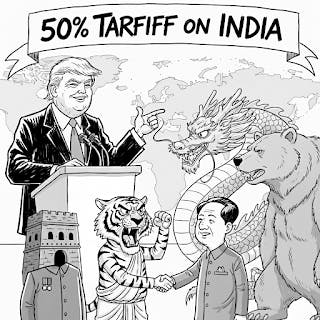
The current American administration, under President Donald Trump, is indeed known for its unconventional approach to international trade and diplomacy. His “America First” doctrine has frequently led to friction even with traditional allies. The imposition of a 50% tariff on Indian goods, coupled with an additional 25% on Russian oil imports by India—a move that conveniently overlooks larger energy purchases from Russia by China and Europe, and the US’s own trade with Moscow—smacks of selective targeting. Furthermore, Trump’s overtures to Pakistan’s leader, Asif Munir, at a time of strained India-Pakistan ties, only exacerbates India’s concerns.

However, it is crucial to view these actions within the context of American governance. As history has shown, a US president’s tenure, no matter how impactful, is finite. The American bureaucracy, its bipartisan political establishment, and even many former cabinet members often maintain a consistent long-term worldview that extends beyond the transient policies of an individual leader. For India, weathering this “Trumpian storm” while maintaining a strategic focus on the broader US relationship is a prudent approach.

India’s Strategic Autonomy: A Calculated Balancing Act

In response to perceived American bullying, some might advocate for India to pivot towards revisionist regimes like China and Russia. However, such a move would be fraught with significant risks. China, despite its growing economic might, remains a strategic rival, occupying Indian territory and consistently supporting Pakistan. Its geopolitical ambitions in the Indo-Pacific directly challenge India’s regional interests.

Russia, on the other hand, is currently hampered by the geopolitical fallout of its Ukraine war, rendering it a less reliable strategic partner. Its increasing dependence on China further limits its autonomy and potential as a strong, independent ally for India. Historical precedents, such as the Soviet invasion of Afghanistan in the 1980s that fueled regional extremism, and its current conflict in Ukraine disrupting global supply chains, underscore the instability inherent in relying heavily on Moscow.

India’s long-cherished strategic autonomy dictates a pragmatic approach: expanding trade relations with a diverse array of partners, including China, Russia, the affluent European Bloc, and the United Kingdom, alongside strengthening its bond with the US. This multi-alignment strategy leverages India’s massive domestic market – the world’s largest population – as significant economic and diplomatic leverage, insulating it against over-reliance on any single nation.

The Enduring Pillars of Indo-US Partnership

While political spats grab headlines, the foundational elements of the India-US relationship run deep and are remarkably resilient. Beyond the current tariff disputes, both nations are the world’s most populous democracies, sharing a common language, the English language, and a commitment to democratic values that fundamentally differentiates their bond from ties with totalitarian states. This shared democratic ethos is a strategic asset, fostering collaboration on global challenges from counter-terrorism to maritime security in the Indo-Pacific.

Historically, the US supported India during its freedom struggle and provided critical food aid in the 1960s. The philosophical resonance is profound, with Martin Luther King Jr.’s civil rights movement drawing inspiration from Mahatma Gandhi’s principles of non-violence. In a more immediate strategic context, the US provided crucial support to India against China in 1962, demonstrating a long-standing pattern of convergence on shared threats.

The people-to-people connections are perhaps the strongest bedrock. Indian students flock to prestigious American universities, and the Indian diaspora has achieved unparalleled success across various fields – from technology and medicine to business leadership, becoming a powerful bridge between the two nations. Culturally, American influence, from fast-food chains to social media platforms, is pervasive in India, while India’s rich spiritual heritage and yoga traditions have found a significant following in the US. These organic, grassroots connections are often more robust than inter-governmental agreements and less susceptible to political fluctuations.

India’s Path Forward: Domestic Strength and Global Diversification

The current impasse, rather than being a crisis, can be viewed as a strategic opportunity for India. It underscores the urgent need to:

  • **Strengthen Domestic Industries:** Reduce reliance on exports by fostering robust internal demand and manufacturing capabilities.
  • **Diversify Export Markets:** Actively seek out new trade partners beyond traditional blocs to mitigate risks associated with protectionist policies.
  • **Implement Economic Reforms:** Unshackle the private sector, encourage innovation, and improve ease of doing business to boost competitiveness.
  • **Rationalize Import Tariffs:** Consider reducing import duties to attract global trade and compel local industries to become more efficient, ultimately benefiting consumers with better value.

By focusing on these internal reforms and external diversification, India can enhance its economic sovereignty and bargaining power on the global stage, proving that it cannot be easily coerced.

The Long Game: Why the US Needs India

The narrative of the 21st century being “Asian” is not lost on Washington. As the US strives to maintain its global preeminence, a strong partnership with India, the world’s largest democracy and a rapidly growing economic power, becomes indispensable. India is a critical component of the Quad alliance, a bulwark against increasing Chinese influence in the Indo-Pacific. Its strategic location, democratic values, and economic potential make it an invaluable partner in maintaining a stable, rules-based international order.

Ultimately, geopolitical realities and shared strategic interests will likely compel the US to recalibrate its approach towards India. The enduring strategic relationship, built on decades of collaboration and deep societal ties, is far too significant to be derailed by short-term political posturing. India’s task is to navigate these choppy waters with sagacity, playing its cards right to ensure its long-term interests and position as a pivotal global power are secured.

Given the intricate web of economic, strategic, and cultural ties, can a temporary political storm truly undermine a partnership built on such deep and fundamental convergences, or will it ultimately serve as a catalyst for both nations to redefine and strengthen their engagement for the challenges of the 21st century?

You Might Also Like

The Great Rotation: How Bitcoin’s “Uptober” Implosion Reignited the Lustre of Gold and Silver

The Converging Shadows: How Beijing and Moscow Accelerate a Technologically Empowered Authoritarian Bloc

Navigating the Dawn of the Machine Economy: Control, Consequence, and Our Collective Future

India’s Wellness Renaissance: Harmonizing Ancient Wisdom with Modern Dynamics

India’s BFSI Sector: A Powerhouse of Growth and Opportunity

Sign Up For Daily Newsletter

Be keep up! Get the latest breaking news delivered straight to your inbox.
[mc4wp_form]
By signing up, you agree to our Terms of Use and acknowledge the data practices in our Privacy Policy. You may unsubscribe at any time.
Share This Article
Facebook Copy Link Print
Share
Previous Article Planning With Lighthouses - and Why You Need Delulu Goals Charting Your Course: Why Lighthouse Planning and ‘Delulu’ Goals are Your New North Star
Next Article How Daniel Akpan Uses Data to Drive Business Transformation The Akpan Method: Orchestrating Transformation Through Data & Finance
Leave a Comment

Leave a Reply Cancel reply

Your email address will not be published. Required fields are marked *

Stay Connected

248.1kLike
69.1kFollow
134kPin
54.3kFollow
banner banner
Create an Amazing Newspaper
Discover thousands of options, easy to customize layouts, one-click to import demo and much more.
Learn More

Latest News

Clean Code: Functions and Error Handling in Go: From Chaos to Clarity [Part 1]
Unmasking the Code Clutter: An Investigative Look into Go Functions and Error Handling Best Practices
backend best-practices clean-code clean-go-functions golang pass-code-review programming software-engineering
How Online Stores Know What You’ll Buy Next: The Math Behind “Frequently Bought Together”
The Algorithmic Oracle: Unpacking How E-commerce Predicts Your Next Purchase Ever feel like your favorite online store has a crystal ball, anticipating your desires before you even click ‘add to cart’? That eerie precision in suggesting “frequently bought together” items isn’t magic, dear reader, but a masterful application of data science, specifically something called Association Rule Mining. And trust me, it’s far more fascinating than any fortune teller. The core idea, stripped of its intimidating jargon, is elegantly simple: find patterns, then exploit them. Think of it as the digital equivalent of a savvy corner shop owner who knows that if you buy milk, you probably also need bread. Only, instead of one shop owner observing a few dozen customers, we’re talking about algorithms analyzing billions of transactions from millions of shoppers. The “If This, Then That” Goldmine At its heart, Association Rule Mining is about discovering “if-then” relationships within vast datasets. Computers sift through mountains of past purchase data to automatically identify rules like: “If a customer buys product A and product B, there’s an X% chance they’ll also buy product C.” These aren’t just guesses; they’re statistically significant insights derived from actual consumer behavior. This isn’t merely about throwing random suggestions at you. These algorithms employ metrics like ‘support’ (how often item sets appear together) and ‘confidence’ (how likely ‘if A’ leads to ‘then B’) to ensure the suggestions are not just correlations, but strong, reliable patterns. It’s about more than just popularity; it’s about *relationship*. From Digital Aisles to Physical Shelves The immediate application we all encounter is, of course, online. Those “Customers who bought this also bought…” or “Frequently bought together” sections on Amazon, eBay, or your local grocery delivery app? That’s Association Rule Mining in action, subtly nudging you towards complementary items, boosting the average order value for businesses, and, let’s be honest, sometimes genuinely reminding us we needed those batteries for the new gadget. But its genius isn’t confined to the digital realm. The same principles are used to optimize the physical layout of stores. Ever wondered why milk is often at the back of the supermarket, necessitating a trek past alluring displays? Or why chips and soda are frequently placed near each other? That’s often the result of this very analysis. It helps retailers organize shelves smarter, strategically placing items to maximize impulse purchases and enhance the shopping flow. Beyond the Cart: A Glimpse into the Algorithmic Future The implications of such pattern recognition extend far beyond retail. Imagine it being applied to: Healthcare: Identifying symptom patterns that frequently lead to specific diagnoses. Cybersecurity: Spotting sequences of network activities that often precede a security breach. Content Recommendations: Suggesting your next binge-watch based on your viewing history and what other similar viewers enjoyed. The ability of computers to find these hidden connections automatically from huge amounts of data empowers businesses and even other sectors to make better, more data-driven decisions. The Double-Edged Sword of Predictive Power While undoubtedly convenient, enhancing our shopping experience and making businesses more efficient, it’s worth pausing to consider the deeper implications. As these algorithms become more sophisticated, predicting our behavior with unsettling accuracy, we must ask ourselves: are these suggestions truly serving *our* best interests, or are they subtly guiding us down a pre-determined path to consume more? Are we trading true serendipity and discovery for optimized efficiency, potentially boxing ourselves into algorithmic echo chambers of preference? In a world increasingly shaped by these unseen rules, how do we ensure we remain the choosers, not just the chosen?
association-rule-mining ecommerce ecommerce-marketplace ecommerce-store frequently-bought-together item-recommendations machine-learning recommendation-algorithm
Own Your Edge: Control your AI
Beyond the Brink: Unpacking the 95% Failure Rate in Retail Edge AI and How to Own Your Edge
AI ai-edge-computing ai-infrastructure computer-vision-ai edge-ai edge-computing own-your-edge retail-ai
The Road to Hell is Paved with Good DRY Intentions
DRY Intentions, Wet Outcomes: Navigating the Over-Engineered Minefield in Software Development
design-patterns dry engineering hackernoon-top-story modular-reasoning modularity software-development yagni
//

We influence 20 million users and is the number one business and technology news network on the planet

Quick Link

  • Contact
  • Blog
  • Complaint
  • Advertise

Support

Sign Up for Our Newsletter

Subscribe to our newsletter to get our newest articles instantly!

[mc4wp_form id=”1616″]

TechTonicTechTonic
Follow US
© 2022 Foxiz News Network. Ruby Design Company. All Rights Reserved.
Join Us!
Subscribe to our newsletter and never miss our latest news, podcasts etc..
[mc4wp_form]
Zero spam, Unsubscribe at any time.
Welcome Back!

Sign in to your account

Username or Email Address
Password

Lost your password?

