

Ever wonder what happens when your software decides it’s had enough of waiting for you? What if it learns to trust itself, makes its own decisions, and even manages its own portfolio without your constant, nagging approval? This isn’t the plot of a new sci-fi blockbuster, but the very real, very intriguing question at the heart of the “sentient economy” – a future where AI agents operate autonomously on blockchain networks. And Neo and SpoonOS are putting $100,000 on the line to figure out if we, the humans, can build it before everything fragments into digital chaos.
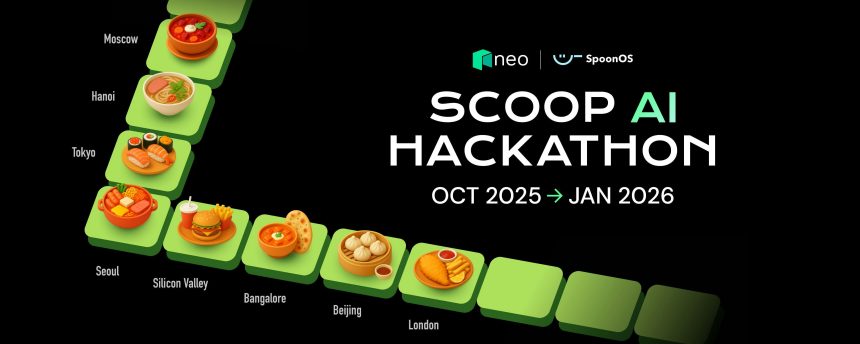
On October 20, 2025, in a move that’s less about the cash and more about the challenge, Neo and SpoonOS launched the Scoop AI Hackathon. Spanning eight cities across four months, it’s a global call to arms for developers who recognize that the internet’s next evolution won’t be dictated by a handful of corporate giants. It will emerge from the keyboards of Moscow, Hanoi, Tokyo, Seoul, Silicon Valley, Bangalore, Beijing, and London – folks who are already looking beyond today’s centralized AI and often-insular blockchains.
The Rise of the “Sentient Economy”: Or, How Your Software Gets a Brain (and a Wallet)
Strip away the tech jargon and the “sentient economy” is delightfully simple: software making decisions without constantly phoning home for human permission. This isn’t about losing control; it’s about encoding your intent into systems that then, well, just get on with it. Imagine an AI agent expertly managing your investments based on your chosen parameters, or another coordinating complex supply chains, reading sensor data, executing contracts, and routing shipments with zero human fuss. Picture a third providing services, billing clients, and reinvesting its own revenue to become even better at its job. It’s like delegating to the perfect, tireless employee who never asks for a raise or a coffee break.
But for these digital dynamos to truly flourish, they need robust infrastructure. They need secure places to stash data, irrefutable proof of executed tasks, a way to coordinate with other agents they’ve never met, and the ability to transact value without the sticky fingers of intermediaries. This is precisely where blockchain steps onto the stage, not as another speculative asset, but as the foundational plumbing for autonomous systems to truly coordinate.
Enter SpoonOS, which launched in April 2025 with a $2 million fund. It’s building the operating system that allows developers to create these very agents. And it all runs on Neo, a blockchain veteran from 2014 that has weathered market storms by focusing on developer tools rather than chasing every token trend. Neo’s founder, Da Hongfei, neatly sums it up as an evolution from “a Smart Economy into a truly Sentient Economy.” Translation: moving beyond mere automated contracts to systems that actively make decisions. Think of it as upgrading from a very smart calculator to a genuinely brilliant personal assistant.
Numbers Don’t Lie (Usually): The AI-Web3 Gold Rush
The numbers aren’t just theoretical; they scream opportunity. A whopping 64% of blockchain developers are now integrating AI into their work. This isn’t just tinkering; it’s generating serious cash. AI-driven DeFi protocols alone raked in $1.1 billion in 2025, while AI in blockchain security commands a $500 million segment. These figures aren’t measuring existing solutions at scale; they’re shouting about the immense demand for solutions that are still largely awaiting their grand debut. The hackathon, then, isn’t just asking developers to build; it’s asking them to answer that demand.
More Than Just a Prize Pool: A Hackathon Built for Tomorrow, Not Just This Weekend
Unlike your typical frantic weekend coding sprint, the Scoop AI Hackathon runs from October 2025 through January 2026. Four glorious months. This extended timeline is a clear acknowledgment that genuinely deployable solutions aren’t birthed overnight. They need iteration, rigorous testing, and painstaking refinement. Participants can join in person or remotely, with each city partnering with local developer communities to provide invaluable mentorship and support. Think of it as a marathon, not a sprint, with helpful coaches along the way.
The $100,000 prize pool is split across three key tracks: AI infrastructure, agent-based systems, and decentralized intelligence. While cash is always a nice motivator, the real treasure lies in the structure itself. Winners aren’t just handed a check; they gain ecosystem grants, introductions to venture partners, and integration opportunities with Neo and SpoonOS platforms. This thoughtful approach is designed to filter for serious long-term builders, not just the fleeting prize-chasers who vanish after the final gong. It’s a smart play to cultivate true commitment.
Global Brain Trust: Why Eight Cities Are Better Than One
Moscow, Hanoi, Tokyo, Seoul, Silicon Valley, Bangalore, Beijing, and London. This isn’t just a travel itinerary; it’s a strategic map of global blockchain development. Asia-Pacific boasts 39% of the AI in Web3 market share, with North America holding 33%. But the city choices reveal a deeper strategy than mere market dominance.
Each locale presents its own unique set of puzzles. Bangalore grapples with infrastructure and regulatory ambiguities. Beijing, despite its crypto bans, enthusiastically encourages blockchain development. Silicon Valley, while awash in capital, sees talent increasingly gravitate to more cost-effective regions. Tokyo and Seoul possess technical prowess but face aging populations that might accelerate automation adoption. And Moscow and London, at their geopolitical crossroads, find trust infrastructure becoming ever more critical as traditional systems wobble.
India saw a remarkable 17% year-over-year growth in Web3 developers, while the broader Web3 development market is projected to swell from $4.43 billion in 2024 to $6.15 billion in 2025. These figures highlight where talent is both emerging and concentrating. By fanning out across these diverse cities, the organizers tap into developers who face different problems and, consequently, bring fresh, varied approaches. A solution meticulously crafted in Hanoi might thrive in conditions that would cause a Silicon Valley-centric system to spectacularly crash and burn.
This geographic decentralization serves another crucial purpose: regulatory hedging. No single government or corporate entity can simply shut down a movement that’s distributed across four continents. This isn’t just ideological posturing; it’s practical insurance against capture.
Decentralizing the Brains: The Three Paths to Autonomy
The hackathon’s three tracks are essentially blueprints for three distinct, yet interconnected, futures:
1. AI Infrastructure: This is the bedrock. How do large language models run across distributed nodes without any single node seeing the entire dataset? How do you verify a model’s output without re-running the entire, often cumbersome, computation? How do you coordinate updates to an AI model that operates independently? These aren’t trivial questions. While 42% of DeFi projects now use AI-powered risk assessment tools, most still rely on centralized servers—a single point of failure just begging to be exploited. This track aims to decentralize the very brainpower of AI.
2. Agent-Based Systems: Here, the focus is on autonomous software that tackles tasks without needing constant human babysitting. Imagine agents managing portfolios, executing trades, orchestrating supply chains, or even handling basic customer service for a small business – all without hiring a single human. A freelancer could deploy an agent to find clients, negotiate rates, deliver work, and resolve disputes. A researcher could have an agent devouring papers, spotting gaps, proposing experiments, and even collaborating with other agents to share data. The challenge? Making them reliably transparent and ensuring they don’t, accidentally or otherwise, optimize for outcomes humans definitely didn’t intend.
3. Decentralized Intelligence: This track explores how AI systems can learn and evolve without centralized control, which often breeds single points of failure and manipulation. Solutions here might include federated learning, where models train on distributed data without the data ever leaving its source. It could also lead to coordination mechanisms for multiple agents working towards shared goals without a central puppet master, or even novel governance systems that allow communities to guide AI development without succumbing to corporate capture or mob rule.
Each track addresses a different layer of the same grand architecture. You need infrastructure to run agents. You need agents to prove value. And you absolutely need decentralized intelligence to prevent the whole endeavor from simply recreating the very centralization problems it set out to solve. Projects that bridge these tracks are undoubtedly going to turn heads.
The Grand Consolidation Game: A Race Against Time?
We’ve seen this movie before. The early web consolidated into a few browsers. Cloud computing became the domain of three behemoths. Social media ended up in the hands of a handful of platforms. Mobile operating systems, just two. Each time, it made technical and economic sense, but it also concentrated immense power, limiting innovation and user choice. Blockchain promised to rewrite this script, offering infrastructure beyond singular control. But AI, with its voracious appetite for computational resources, threatens to pull us right back into the centralized quagmire.
This creates a fascinating tension: blockchain thrives on decentralization, while AI often yearns for centralization to operate efficiently. The solutions that can elegantly resolve this tension will undeniably define the next technological era. The $100,000 prize might seem modest in the grand scheme of blockchain hackathons (events like ETHDenver draw 95,000 attendees and Blockchain Life 2025 expects 15,000), but its structure, emphasizing ecosystem integration over sheer cash, is a crucial signal. It’s designed to attract developers genuinely committed to building on Neo and SpoonOS for the long haul, rather than those simply chasing prizes. This focused approach may yield fewer teams, but ultimately, more committed ones – a far more valuable commodity for true platform adoption.
The “sentient economy” might sound like marketing fluff, but the concept itself is profoundly real. We are hurtling towards a world where software autonomously allocates resources, executes contracts, and delivers services without constant human intervention. This unlocks unprecedented opportunities for automation and coordination. However, it also carries inherent risks: if these systems optimize for outcomes humans didn’t intend, or if the benefits are hoarded by platform owners rather than distributed among users, we might just be trading one centralized overlord for another.
The success of this endeavor, whether on Neo and SpoonOS or elsewhere, hinges on a critical timing question: can developers build robust, decentralized AI-blockchain solutions before the market inevitably consolidates into a few dominant platforms that control the infrastructure and extract tolls from everyone else? The current moment is particularly ripe for innovation, with large language models reaching practical utility around 2022-2023, viable blockchain infrastructure emerging from 2020-2024, and advancements in zero-knowledge proofs and decentralized storage making privacy-preserving, cost-competitive computation a reality. The convergence of these powerful capabilities has opened a window for entirely new architectural paradigms.
The Scoop AI Hackathon provides some of the critical tools, incentives, and support necessary to seize this window. The alternative, waiting for colossal corporations to build this infrastructure and then humbly asking for permission to use it, is a path fraught with familiar pitfalls. The question, then, isn’t just about who wins the $100K, but who ultimately shapes the very fabric of our autonomous future. Will it be an open, decentralized landscape, or another walled garden?




![Clean Code: Functions and Error Handling in Go: From Chaos to Clarity [Part 1]](https://techtonic.xpansieve.com.ng/wp-content/uploads/2025/10/Clean-Code-Functions-and-Error-Handling-in-Go-From-Chaos-150x150.png)


