

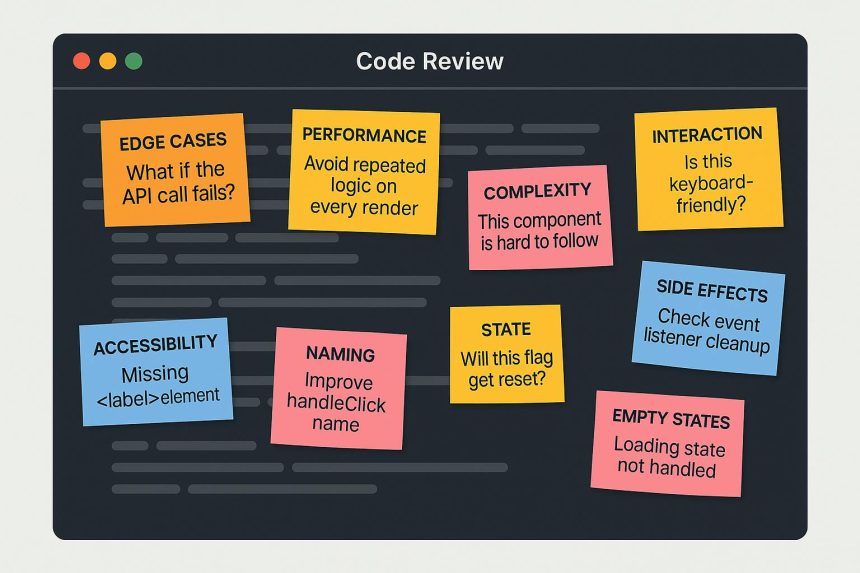
Elevating Frontend Code Reviews: Moving Beyond Syntax to User Experience Excellence
In the fast-paced world of web development, frontend code reviews are a critical gatekeeper for quality. Yet, a common pitfall is that many reviews, while seemingly efficient, often “pass quickly” without truly scrutinizing what matters most: the end-user experience. This superficiality can lead to a host of issues, from subtle UI glitches to significant accessibility barriers, all of which ultimately degrade product quality and user trust.
The Hidden Traps: What Standard Reviews Often Miss
The core challenge lies in shifting our focus from merely validating code structure and logic to comprehensively evaluating the actual product in action. The traditional approach frequently overlooks crucial user-facing aspects. As observed, reviews often:
- Neglect System Failures and Unforeseen Side Effects: A quick glance might confirm a feature “works,” but does it handle edge cases gracefully? What happens when an API call fails, or an unexpected user interaction triggers an unintended state change? These are the real-world scenarios that break user flows and erode confidence.
- Bypass User-Centric Accessibility Checks: Elements like “missed labels” for input fields, “broken focus traps” for keyboard navigation, and “missing headings” for semantic structure are vital for users with disabilities and for overall search engine optimization. These aren’t just compliance checkboxes; they are fundamental to inclusive design and a seamless experience for all.
- Overlook Visual Fidelity and Responsiveness: Is the component pixel-perfect across different browsers and devices? Does it maintain its intended layout and aesthetic on various screen sizes, or do elements misalign, overlap, or become unreadable?
- Disregard Performance Bottlenecks: While code might be functional, is it efficient? Slow loading times, janky animations, or excessive network requests directly impact user engagement and can lead to abandonment.
A Paradigm Shift: Cultivating User-Centric Reviewers
To truly elevate frontend quality, we must cultivate a culture where code reviews are not just about finding bugs but about proactively ensuring a delightful and accessible user experience. This requires a shift in mindset:
- Embrace the User’s Persona: Reviewers should step into the shoes of the end-user, considering various contexts, devices, and potential limitations.
- Think Beyond the Happy Path: Actively test error states, empty states, loading states, and edge cases that often get neglected.
- Prioritize Accessibility: Make accessibility checks a standard, non-negotiable part of every frontend review, integrating tools and manual keyboard testing.
Actionable Strategies for Elevated Frontend Reviews
Implementing these changes requires a structured approach. Here are practical strategies to transform your code review process:
- Develop Comprehensive Checklists: Move beyond mere linting. Include items related to accessibility (ARIA attributes, keyboard navigation, contrast ratios), responsiveness, performance (Lighthouse scores), error handling, and cross-browser compatibility.
- Integrate Automated Accessibility Tools: Tools like Axe, Pa11y, or Lighthouse’s accessibility audits can catch many issues early. However, remember they complement, but don’t replace, manual testing.
- Mandate Keyboard Navigation Testing: Every interactive component should be navigable and usable purely with a keyboard. Check for correct tab order, focus indicators, and operable controls.
- Perform Visual Regression Testing: Use tools that compare screenshots of UI components across different builds or browsers to catch unintended visual changes.
- Collaborate with UX and QA: Foster a culture where UX designers provide input during reviews on visual fidelity and user flow, and QA engineers contribute their expertise on edge cases and system integration.
- Review Features in Context: Instead of isolated code snippets, reviewers should deploy the feature locally or in a staging environment to experience it as a user would.
The ROI of True Quality: Benefits Beyond Bug Fixes
Investing in more thorough, user-centric frontend reviews yields significant returns:
- Enhanced User Satisfaction: A polished, accessible, and high-performing frontend leads to happier users and stronger engagement.
- Reduced Technical Debt and Bug Reports: Catching issues earlier in the development cycle is always more cost-effective than fixing them post-deployment.
- Improved SEO and Brand Reputation: Accessible and performant websites rank higher and build a more trustworthy brand image.
- Empowered Development Team: Developers grow by learning to consider the broader impact of their code, fostering a culture of quality and empathy.
As we push the boundaries of frontend innovation, are our code review processes truly evolving to meet the demands of an increasingly diverse and sophisticated user base, or are we still inadvertently leaving critical user experiences to chance?




![Clean Code: Functions and Error Handling in Go: From Chaos to Clarity [Part 1]](https://techtonic.xpansieve.com.ng/wp-content/uploads/2025/10/Clean-Code-Functions-and-Error-Handling-in-Go-From-Chaos-150x150.png)


