

The CSS Conundrum: Is Our Obsession with Reinvention Hiding Deeper Styling Pains?
For years, web developers have grappled with the complexities of styling, often pointing fingers at CSS itself as the source of all pain. Yet, as Den Odell provocatively suggests, this endless cycle of reinventing CSS might be a profound misdirection. What if the language isn’t the problem, but rather the symptoms it highlights about how we build for the web?
The Reinvention Treadmill: A Futile Pursuit?
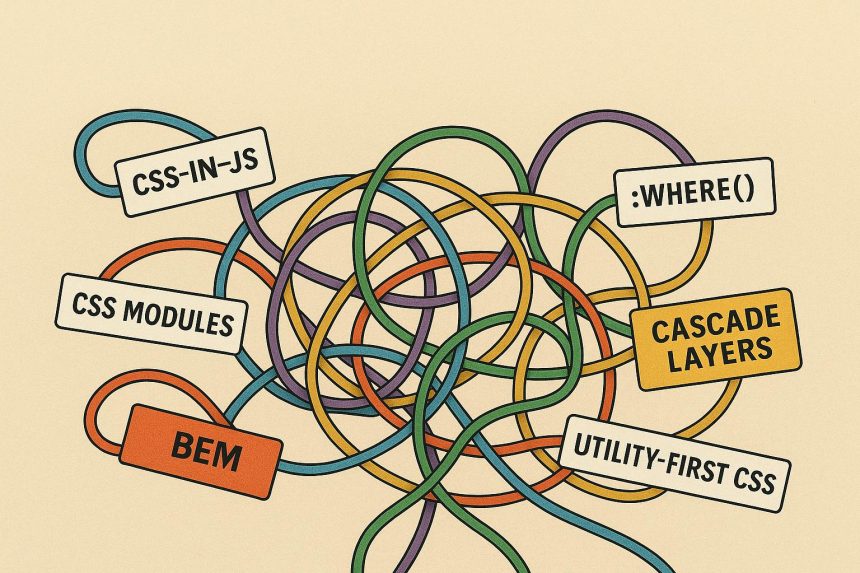
Odell observes that we’ve poured immense effort into “bolting on strategies to make it work.” This rings true across the industry. From the early days of semantic CSS methodologies like BEM and SMACSS, through preprocessors like Sass and Less, to the modern era of CSS-in-JS, utility-first frameworks like Tailwind CSS, and even component-scoped styles, the quest for better styling solutions has been relentless.
Each approach promises to mitigate a specific set of pains:
Specificity Wars: Methodologies like BEM aimed to flatten the cascade and reduce unpredictable style conflicts, offering more predictable outcomes.
Scalability: Preprocessors offered variables, mixins, and nesting to manage larger, more organized codebases.
Component Isolation: CSS-in-JS and module systems sought to tie styles directly to components, reducing global scope pollution and enhancing modularity.
Development Speed: Utility-first frameworks provided ready-made classes for rapid UI construction, emphasizing efficiency.
While each strategy has its merits and has undeniably improved developer workflows in certain contexts, Odell’s critical insight is that “none of them quite fit.” This isn’t a critique of the tools themselves, but rather an implication that the underlying problem isn’t inherent to CSS’s syntax or cascade model. Instead, perhaps it lies in the very nature of web application development and the increasing complexity of user interfaces.
Beyond the Language: Unpacking the Real Challenges
If CSS isn’t the root cause, what is? The true pain points might be broader, encompassing aspects of:
Project Scale and Team Coordination: As applications grow, maintaining a consistent visual language across hundreds or thousands of components with multiple developers becomes a monumental task. The challenge isn’t just writing CSS, but managing its evolution and application lifecycle.
Design System Implementation: Translating abstract design principles into concrete, reusable code is inherently complex. This often involves bridging the gap between designers and developers, ensuring design tokens are applied consistently, and handling variations and edge cases across platforms.
Performance and Load Times: The sheer volume of CSS required for rich UIs can lead to performance bottlenecks. Optimizing for critical rendering paths, tree-shaking, and lazy loading styles adds layers of necessary, yet complex, engineering.
Maintainability and Legacy Code: Over time, styling codebases can become brittle, leading to significant “stylesheet debt.” Refactoring CSS without introducing regressions is a common nightmare, regardless of the chosen methodology or framework.
The Ever-Evolving Web Platform: New CSS features (Grid, Flexbox, Container Queries, etc.) continuously emerge, offering powerful capabilities but also requiring adaptation and strategic integration into existing systems. This constant learning curve contributes to perceived pain and the feeling of never quite catching up.
These challenges transcend the specifics of CSS syntax. They are systemic issues related to software architecture, team dynamics, design processes, and the inherent complexity of building interactive, responsive web experiences at scale.
Which Pain Are You Willing to Accept?
Den Odell’s concluding question is perhaps the most profound: “Which Pain Are You Willing to Accept?” This isn’t a call for a perfect, pain-free styling solution, because such a thing likely doesn’t exist. Instead, it’s an acknowledgement that every approach comes with its own set of trade-offs, and choosing one means consciously opting for a particular set of challenges.
Consider the trade-offs:
Do you accept the pain of a global cascade for its simplicity and directness in small, contained projects?
Do you accept the verbose class names and strict methodology of BEM for the sake of predictable, isolated styling?
Do you accept the build-tool dependency and potentially larger bundle sizes of CSS-in-JS for component co-location and dynamic styling capabilities?
Do you accept the learning curve and opinionated nature of a utility-first framework for the promise of rapid, constrained development?
The answer is rarely universal. The optimal styling strategy depends heavily on factors like project size, team expertise, design requirements, and long-term maintainability goals. It forces teams to be intentional about their choices, rather than blindly following the latest trend or simply blaming the tools.
Ultimately, the continuous reinvention of CSS highlights a deeper truth: styling is hard, not because CSS is fundamentally flawed, but because the demands on modern web interfaces are incredibly complex. Perhaps instead of endless reinvention, the focus should shift to fostering better collaboration between design and development, building more robust design systems, and making deliberate, informed choices about the tools we use, understanding their inherent trade-offs.
Are we stuck in a loop of reinventing the wheel, or are these “reinventions” simply reflections of an evolving understanding of the web’s true styling challenges?




![Clean Code: Functions and Error Handling in Go: From Chaos to Clarity [Part 1]](https://techtonic.xpansieve.com.ng/wp-content/uploads/2025/10/Clean-Code-Functions-and-Error-Handling-in-Go-From-Chaos-150x150.png)


