

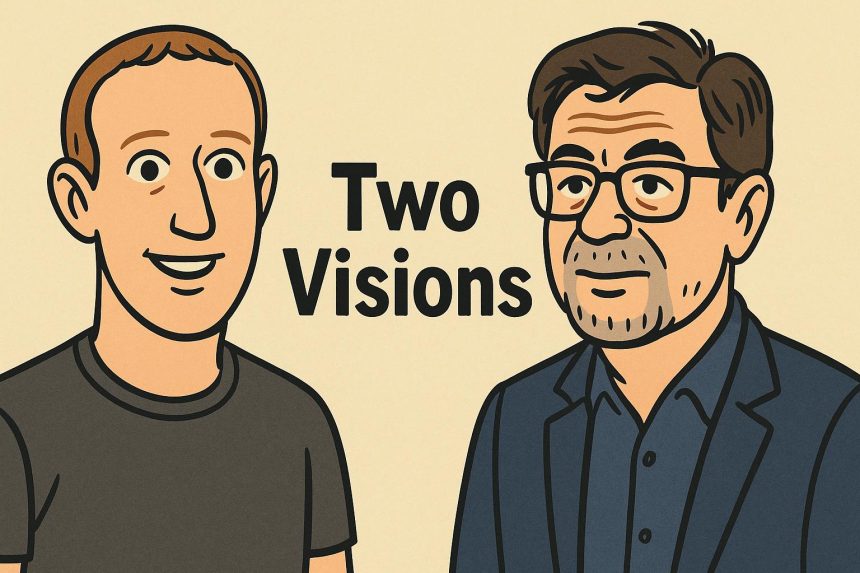
Meta’s AI Divide: Zuckerberg’s Personal Superintelligence vs. LeCun’s Open World Models
The pursuit of Artificial Intelligence isn’t merely a technological race; it’s a deep philosophical exploration of humanity’s future. Even within Meta, a tech titan, two of its most influential figures, CEO Mark Zuckerberg and Chief AI Scientist Yann LeCun, champion remarkably distinct visions for AI’s evolution and purpose. Their individual perspectives, shaped by their roles and expertise, bring to light the complex strategic and ideological decisions confronting the global AI community.
Yann LeCun’s Blueprint: Architecting an Open Future Beyond LLMs
Yann LeCun, a foundational figure in deep learning, consistently advocates for a groundbreaking, almost purist, approach to AI advancement, prioritizing radical openness and a fundamental architectural shift away from current Large Language Models (LLMs). His position is resolute:
“Closed/proprietary strategies slow down overall progress,” a point he has become increasingly vocal about as prominent American AI companies “started clamming up.”
LeCun sees “openness not just as a philosophy, but as a crucial catalyst,” emphasizing that “the future of AI hinges on collaboration, not isolation.” This translates to an imperative for a robust “open source / open weight / open research approach to AI,” advocating for “the full disclosure of the PUBLIC training and testing data also.” He posits that open research and accessible weights are vital for inclusive, diverse, faster, and broader innovation, citing Meta’s success with PyTorch and LLaMA, the latter boasting over a billion downloads, as proof of this powerful philosophy.
Perhaps LeCun’s most pronounced departure from prevailing industry trends is his skepticism regarding LLMs as the ultimate pathway to advanced machine intelligence. He states, “I’m not so interested in LLMs anymore. They’re kind of the last thing.” He perceives them as being “in the hands of industry product people, kind of improving at the margin, trying to get more data, more compute.” Crucially, he believes their method of reasoning is “very simplistic” and dismisses the notion that merely scaling LLMs will lead to human-level intelligence as “nonsense” and “wrong.”
Instead, LeCun champions future AI architectures designed to comprehend the physical world, equipped with persistent memory, and capable of genuine reasoning and planning. He argues that engaging with the real world is “much more difficult… than to deal with language,” as language is discrete, while natural data is high-dimensional and continuous. His proposed solution is the Joint Embedding Predictive Architecture (JAPA or JPA), which seeks to learn “abstract representations” of sensory inputs like images, video, or natural signals, making predictions within this “abstract representation space” rather than at a granular pixel or token level. This approach, he explains, avoids the wasteful resource allocation inherent in pixel-level prediction where systems attempt to invent unpredictable details. For agentic systems capable of reasoning and planning, JAPA offers a predictor that can model “the next state of the world given that I might take an action that I’m imagining taking.” This, he contends, mirrors how humans truly reason and plan, “not in token space.” He sharply differentiates this from current “agentic reasoning systems” that generate and sift through thousands of token sequences, labeling such methods “completely hopeless” for authentic reasoning.
LeCun prefers the term Advanced Machine Intelligence (AMI) over AGI, noting that human intelligence is “super specialized,” rendering “general” a misnomer. He optimistically projects that we could achieve a “good handle on getting this to work at least at a small scale within three to five years,” with scaling to human-level AMI potentially occurring “within a decade or so.” He envisions AI as a tool to enhance human productivity and creativity, serving as “power tools” rather than replacements, with humans acting as the “boss” to “a staff of super-intelligent virtual people.”
Mark Zuckerberg’s North Star: Personal Superintelligence for Everyone
Mark Zuckerberg’s vision, epitomized by Meta’s “Super Intelligence Labs” initiative, is the relentless pursuit of “personal super intelligence for everyone”. He believes developing superintelligence is “now in sight,” with early indicators of AI systems “improving themselves” already perceptible. Zuckerberg’s optimism extends to superintelligence accelerating humanity’s overall progress, but he underscores an “even more meaningful impact” derived from its personal application.
His foundational belief is that AI should empower individuals to achieve their personal ambitions and goals. A personal superintelligence, in his view, would assist users in their quest to “create what you want to see in the world, experience any adventure, be a better friend to those you care about, and grow to become the person you aspire to be.” This perspective explicitly contrasts with “others in the industry who want to direct AI at automating all of the valuable work,” which could lead to humanity living “on a dole of its output.” Zuckerberg asserts Meta’s conviction in “putting the power of super intelligence in people’s hands to direct it towards what they value in their own lives.” He frames this as a continuation of historical trends where technology liberates humanity from subsistence, allowing focus on “creativity, culture, relationships, and just enjoying life.”
Zuckerberg anticipates a future where people devote “less time in productivity software, and more time creating and connecting.” He foresees personal devices like smart glasses becoming “our primary computing devices,” capable of understanding context by observing and hearing our actions, and engaging with us throughout the day.
Regarding openness, Zuckerberg echoes a sentiment similar to LeCun’s: “We believe the benefits of superintelligence should be shared with the world as broadly as possible.” However, he immediately introduces a crucial caveat: “That said, superintelligence will raise novel safety concerns. We’ll need to be rigorous about mitigating these risks and careful about what we choose to open source.” He reaffirms Meta’s significant resources and unwavering commitment to building the requisite “massive infrastructure” and deploying this technology to “billions of people across our products.” He views the current decade as “the decisive period for determining the path this technology will take, and whether superintelligence will be a tool for personal empowerment or a force focused on replacing large swathes of society.”
The Philosophical Fault Line: Beyond Shared Slogans
While both Zuckerberg and LeCun are foundational to Meta’s AI endeavors and superficially share a commitment to “openness” and AI’s positive societal impact, a deeper examination unveils significant philosophical and strategic divergences that could profoundly shape AI’s future trajectory.
The most conspicuous difference lies in their technical pathways to advanced AI. LeCun openly dismisses LLMs’ capacity for genuine intelligence and reasoning, championing entirely new “world models” and JAPA architectures that learn abstract representations and plan in latent space. He labels the current LLM trajectory as “nonsense” for achieving human-level intelligence. Zuckerberg, conversely, speaks broadly of “superintelligence” becoming “in sight” through “AI systems improving themselves,” without specifying a departure from the LLM paradigm. This hints at a fascinating internal tension: could Meta, under Zuckerberg’s direction, be heavily investing in a path that its chief AI scientist believes is fundamentally inadequate for true intelligence?
Furthermore, their interpretations of “openness” reveal a subtle yet critical distinction. LeCun’s advocacy for “robust open source / open weight / open research” and “full disclosure of the PUBLIC training and testing data” is nearly absolute. He views it as the fundamental accelerator for progress, arguing that “no single entity is going to be able to do this by itself” and that proprietary platforms “are going to disappear.” Zuckerberg, while agreeing on broadly sharing benefits, adds the critical qualifier: “careful about what we choose to open source” due to “novel safety concerns.” This caveat, while seemingly prudent, introduces a mechanism for corporate control over the flow of innovation. It raises questions about whether “personal superintelligence for everyone” will truly be open and adaptable by the global community, or if it will be a Meta-defined and Meta-controlled ecosystem, albeit widely distributed. As Clément Delangue, Hugging Face CEO, observes, “U.S.-based companies; many of which pioneered the modern AI revolution are increasingly closing up,” potentially leading American AI to build on open foundations from other regions. LeCun’s concerns about prominent American AI companies “clamming up” and the risk of silos that stifle progress directly echo this observation.
Implications and The Road Ahead
This profound divergence carries significant implications for the future of AI development. If LeCun’s technical assessment is accurate, and LLMs are indeed a “simplistic way of viewing reasoning” incapable of leading to true advanced intelligence, then a substantial portion of industry investment, potentially including Meta’s “SuperIntelligence Labs,” might be directed down a less optimal path. This could delay genuine breakthroughs in crucial areas such as physical world understanding, persistent memory, and sophisticated reasoning.
Conversely, if Zuckerberg’s “personal superintelligence,” even if built on existing paradigms, can genuinely empower billions and foster creativity as he envisions, its widespread deployment could fundamentally transform human-AI interaction. The pivotal question then becomes whether this personal empowerment is best achieved through a single, powerful entity like Meta controlling the core architecture and selectively open-sourcing, or through the truly decentralized, pervasive innovation that LeCun champions. The “careful about what we choose to open source” approach could paradoxically hinder the very “rapid experimentation, lower barriers to entry and create compounding innovation” that open source proponents like LeCun and Delangue believe is essential for leadership in the global AI race.
The strategic stakes are undeniably high. LeCun’s vision points toward a future where AI progress is a globally distributed, collaborative effort, driven by the collective ingenuity of an open community. Zuckerberg’s vision, while sharing the goal of broad accessibility, positions Meta as the central architect and primary deliverer of this future, with a more controlled release of its underlying technologies.
Which approach ultimately promises the greatest innovation and serves humanity most effectively? Is true “superintelligence” merely an upscaled version of current models, or does it necessitate a fundamental architectural reimagining as radical as LeCun suggests? And can a single corporation, no matter how well-intentioned, genuinely champion universal empowerment while retaining ultimate control over the very technologies that define it? The answers to these questions will not only shape the next decade of AI but potentially the very nature of human progress.




![Clean Code: Functions and Error Handling in Go: From Chaos to Clarity [Part 1]](https://techtonic.xpansieve.com.ng/wp-content/uploads/2025/10/Clean-Code-Functions-and-Error-Handling-in-Go-From-Chaos-150x150.png)


