

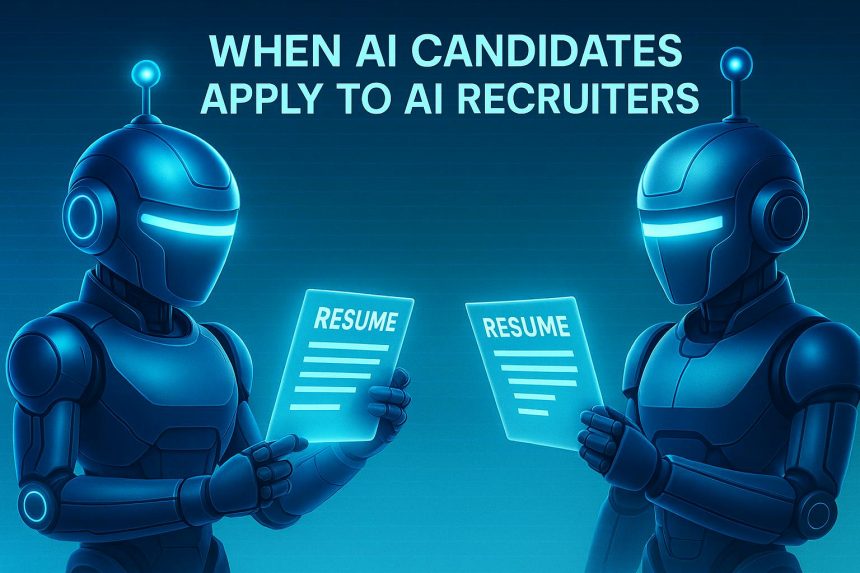
In the digital corridors of the modern job market, a quiet revolution has been brewing. Or perhaps, a quiet automation battle, depending on your perspective. Raymond Guo, cofounder of Noon AI, has had a front-row seat to this evolving landscape, observing a peculiar phenomenon: both sides of the hiring equation are now arming themselves with AI. Candidates are leveraging GPT-powered agents to churn out resumes and cover letters, while recruiters are deploying their own algorithmic gatekeepers. The result? A fascinating, if somewhat unsettling, scenario where bots are, quite literally, applying to bots.
The Job Market: Where Every Application is an AI-Fueled Skirmish
Forget the quaint notion of a human pouring over a meticulously crafted cover letter. We’ve entered an era where the job market isn’t just competitive; it’s an outright AI arms race. On one flank, ambitious candidates are deploying tools like LazyApply, Sonara, and Simplify, transforming job seeking into a mass-application spree. Hundreds of roles, tailored resumes, auto-generated cover letters – all orchestrated by an AI bot that probably needs less coffee than you do. This isn’t just efficiency; it’s an application blitzkrieg, and the resulting “spam at scale” is enough to make any inbox weep.
But fear not, corporate gatekeepers, for the recruiting world has its own digital weaponry. Resume screeners, candidate rankers, and automated outreach tools are the new sentinels of opportunity. Your carefully curated resume? It’s likely being parsed, analyzed, and judged not by a hiring manager, but by an algorithm. Human recruiters, in many cases, are simply no longer reading most applications. The bots are on patrol, and the loop, my friends, is complete: bots applying to bots.
The Echo Chamber of Automation: When Nobody’s Actually Communicating
This escalating digital duel has transformed the hiring process into something resembling a high-stakes game of SEO. Candidates’ AI agents endlessly tweak resumes, hunting for keywords to slip past automated filters. Recruiters’ AI agents, in turn, are constantly updated to detect those very same AI-generated resumes. It’s a continuous, algorithmic cat-and-mouse game, but with a far more significant prize than search engine ranking: people’s livelihoods.
The human element, once central to recruiting—the connection, the alignment of ambition with opportunity—has largely been sidelined. It’s now a chess match between two language models, with our careers as the pawns. The numbers are telling: an average recruiter spends less than seven seconds on a resume, while a candidate dedicates under ten seconds to personalizing an application. This isn’t a talent market; it’s an API call, a cold, calculated data exchange devoid of warmth or genuine understanding.
The Automation Feedback Loop: A Whirlwind of Synthetic Logic
The cycle of automation feeding counter-automation is both impressive and a little terrifying:
- Candidates optimize prompts: “Write a cover letter that passes an ATS scan.”
- Recruiters counter: “Detect ChatGPT-generated resumes.”
- Candidates respond: “Rephrase to sound more human.”
- Recruiters add: “Evaluate sentence entropy for authenticity.”
At some point, the origin of the text becomes irrelevant. Who wrote what? Who cares! The system hums along, dutifully evaluating synthetic text with an equally synthetic logic. The true danger here isn’t merely efficiency gone wild. It’s the erosion of meaning. If both sides delegate judgment to AI, what does “fit” even mean anymore? Is it the perfect algorithmic match, or something more profound that only a human can discern?
The Paradox of Efficiency: Drowning in Faster Noise
Automation promises speed and efficiency. But what if everyone automates? The noise doesn’t disappear; it simply accelerates. A candidate’s edge no longer stems from superior writing or genuine passion, but from deploying a slightly smarter AI. A recruiter’s advantage isn’t found in empathy or interviewing prowess, but in training a marginally better model. The market risks collapsing into algorithmic symmetry, where both sides endlessly optimize against the other, eventually blurring all signals into indistinguishable noise. Welcome to hiring entropy, where everything blends into a vast, digital hum.
Charting the Uncharted: Possible Futures
So, where does this digital arms race lead us? Several scenarios loom:
- Scenario 1: Full Automation. Imagine a world where AI agents apply, screen, interview, and even negotiate terms with each other. Humans merely step in to rubber-stamp the outcomes. A job offer becomes the output of an API transaction, swift and emotionless.
- Scenario 2: Algorithmic Collapse. Overwhelmed by the sheer volume of AI-generated noise, companies might recoil. They could revert to old-school methods: referrals, trusted networks, and carefully curated shortlists. Hiring through humans could become a premium, bespoke experience, much like savoring artisan coffee in an age of instant gratification.
- Scenario 3: The Equilibrium. This feels like the ideal middle ground. AI handles the grunt work – the filtering, the initial screenings. Humans re-enter the equation where it truly counts: assessing culture fit, evaluating creativity, building trust, and making the nuanced judgments only a person can.
The Recruiting Protocol: A Call for Digital Diplomacy
Perhaps it’s time we stopped pretending these bots aren’t talking to each other and, instead, gave them a structured language to communicate. Raymond Guo proposes a “Recruiting Protocol”—a standardized, transparent method for candidate agents and recruiter agents to exchange structured data instead of endless, keyword-stuffed text.
Instead of the vague pleasantries of “Dear Hiring Manager,” an AI agent could transmit precise data:
{
  "skills": ["Python", "TensorFlow", "Cloud Infrastructure"],
  "experience_years": 5,
  "career_intent": "Machine Learning Engineer",
  "project_samples": ["github.com/example/project"]
}
And recruiter agents could respond with equally clear requirements:
{
  "required_skills": ["Python", "Kubernetes"],
  "salary_band": "$140k-$160k",
  "seniority": "Mid-Level"
}
No more keyword stuffing, no fake personalization, just structured, transparent, and fair communication. It’s the equivalent of SMTP for hiring: a clear protocol that cuts through the noise. In this future, recruiting becomes a data exchange problem, not a guessing game. And AI? It stops trying to mimic humanity and starts doing what it does best: the job, better than we ever could.
The Human Opportunity: Reclaiming Our Essence
If AI truly takes over the transactional, logistical layers of hiring, what then remains for us humans? This shift could be a profound opportunity. We could finally pivot our focus to what truly matters:
- Defining the core mission and purpose of our organizations.
- Calibrating and nurturing a vibrant company culture.
- Crafting environments where people don’t just work, but truly thrive and do their best work.
The more AI handles the endless paperwork and algorithmic gatekeeping, the more recruiting can return to its fundamental essence: understanding people. Perhaps the future of hiring isn’t about entirely removing humans, but rather about meticulously removing everything that isn’t inherently human from the process. What will we discover about ourselves, and our definition of meaningful work, when the digital dust finally settles?




![Clean Code: Functions and Error Handling in Go: From Chaos to Clarity [Part 1]](https://techtonic.xpansieve.com.ng/wp-content/uploads/2025/10/Clean-Code-Functions-and-Error-Handling-in-Go-From-Chaos-150x150.png)


