

Understanding the VIX: The Market’s Barometer of Fear and Opportunity
In the bustling world of financial markets, understanding sentiment can be as crucial as analyzing balance sheets. That’s where the VIX comes in – often dubbed the “fear index.” But what exactly is this mysterious metric, and how can it empower investors and traders?
What is the VIX? Unpacking the Volatility Index
The Volatility Index, or VIX, was introduced by the Chicago Board Options Exchange (CBOE) in 1993. At its core, the VIX isn’t a forecast of whether stock prices will rise or fall. Instead, it measures the market’s expectation of volatility over the next 30 days. It does this by analyzing the prices of options tied to the S&P 500 index – a basket of 500 large U.S. companies that serves as a benchmark for the overall stock market.
Think of the VIX as a market barometer. Just as a barometer measures atmospheric pressure to hint at future weather, the VIX measures perceived market turbulence. A high reading indicates stormy conditions ahead, while a low reading suggests calmer seas.
Decoding VIX Readings: Highs and Lows
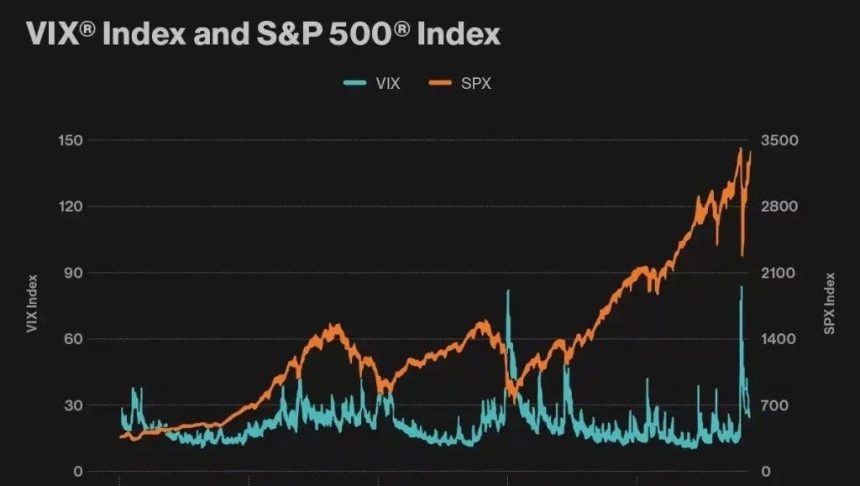
The numbers on the VIX chart tell a powerful story:
- High VIX (over 30-40): Sign of Fear. When the VIX spikes above 30 or 40, it signals widespread fear, uncertainty, and potential panic among investors. We saw this dramatically during the 2008 financial crisis and the sharp market decline in March 2020 due to COVID-19, when the VIX soared past 80. These moments represent periods of intense expected price swings.
- Low VIX (between 10-20): Sign of Calm. Conversely, a VIX reading between 10 and 20 typically indicates investor confidence and market stability. These lower levels are common during stable bull markets, reflecting a collective belief in smoother sailing ahead.
Applying the VIX in Your Trading Strategy
Beyond being a mere indicator, the VIX offers practical insights for traders looking to navigate market swings and manage risk.
1. Spotting Contrarian Opportunities
A sudden spike in the VIX often correlates with an oversold market – a point where assets might be undervalued due to excessive selling driven by fear. For a contrarian investor, who thrives on going against the prevailing sentiment, this can signal a potential buying opportunity. For instance, the VIX surge during the 2020 crash was followed by a significant market rally, rewarding those who had the conviction to buy during peak uncertainty.
Conversely, extremely low VIX readings (below 15) could suggest an overbought market, indicating that prices might be inflated and a correction could be imminent. These insights help traders determine opportune entry and exit points.
2. Enhancing Risk Management
The VIX is also an invaluable tool for tailoring your risk management strategy:
- High Volatility: When the VIX is high, indicating significant expected price movements, it’s generally wise to consider taking smaller positions or setting wider stop-loss orders. This gives your trades more breathing room and protects against sudden, large swings.
- Low Volatility: In calmer periods with a low VIX, you might comfortably take larger positions, as the market is expected to be more predictable.
3. Timing Swing Trades with VIX Trends
Swing traders, who aim to profit from short-to-medium term price movements, can leverage VIX trends to refine their timing:
- Rising VIX: A VIX on the rise suggests increasing short-term price drops. Waiting for conditions to stabilize before entering new positions might be a prudent decision.
- Decreasing VIX: A falling VIX, perhaps from 30 down to 20 over a week, signals market stabilization. This could present an ideal window to buy shares in companies poised for recovery, anticipating a return to growth.
4. Hedging with VIX Products
For those looking to directly manage risk, VIX-linked financial products can serve as hedges. For example, an instrument like the iPath S&P 500 VIX Short-Term Futures ETN (VXX) can be used to offset potential losses in other parts of your portfolio. If you hold technology stocks and anticipate a market correction, buying some VXX could help hedge against those expected declines.
The VIX is far more than just a number; it’s a dynamic reflection of market psychology and a powerful analytical tool. By understanding its nuances, investors can gain a clearer perspective on market sentiment, refine their trading strategies, and manage risk more effectively.
How might your own investment decisions change if you consistently incorporated the VIX into your market analysis?




![Clean Code: Functions and Error Handling in Go: From Chaos to Clarity [Part 1]](https://techtonic.xpansieve.com.ng/wp-content/uploads/2025/10/Clean-Code-Functions-and-Error-Handling-in-Go-From-Chaos-150x150.png)


