

In the fast-evolving world of product development, some innovations are a natural progression, while others force a complete reevaluation of core assumptions. For one particular team, building advanced mobile weather widgets proved to be the latter, pushing the boundaries of instant information access.
For years, their efforts were concentrated on refining radar accuracy, ensuring frequent data updates, and mastering real-time storm tracking within their flagship application. However, as their user base expanded, especially among those who check weather forecasts multiple times a day, a crucial need emerged: the ability to access vital weather information instantaneously, without even opening an app.
This growing demand compelled them to fundamentally rethink how weather data is delivered on mobile devices. The goal wasn’t merely to create ‘mini-apps,’ but to surface the most critical insights in the most accessible and immediate way possible.
The Growing Appetite for At-a-Glance Weather
The belief that weather data should be glanceable, not hidden within layers of menus, has long been a guiding principle. This led their app, Rain Viewer, to offer home screen widgets on Android as early as 2016, predating widespread user expectation.
However, by late 2021, a new pattern began to emerge in user support queries: a consistent influx of questions like, “Does your app offer a radar widget for iPhone?” and “Can I replace Apple’s widget with yours?” At that time, Apple had only recently introduced widget support on iOS. Recognizing the clear demand, the team was already proactively developing native widgets, poised to launch the moment technical feasibility aligned with their vision.
Their user base—a diverse group of weather enthusiasts, dedicated storm chasers, and data-driven planners—didn’t passively await weather events. They actively tracked atmospheric changes with the same intensity some monitor financial markets, requiring swift, at-a-glance access across all their devices.
The Vision: Redefining the Widget Experience
The ambition extended beyond simply mimicking existing features; the aim was to engineer a superior, highly customizable user experience. This involved a commitment to several key enhancements:
- Ultra-fast data updates, refreshed every 15 minutes for all users.
- A completely free radar map widget, offering unparalleled access.
- Extensive customization options, including map type, opacity, zoom level, and radar layers.
- An adaptive design ensuring seamless functionality across both Android and iOS platforms.
Their guiding principles were clear: precision, personalization, and instant readability.
Technical Hurdles: Why Widgets Aren’t Mini-Apps
A fundamental reality in widget development is that these small, interactive elements are not full applications. Their functionality is significantly constrained by operating system limitations. On Android, widgets operate with restricted execution, and on iOS, these limitations are even more pronounced. iOS widgets are essentially static views that must update in the background, independently and with severely limited direct user interaction.
Core challenges faced during development included:
- Battery-Efficient Background Updates: Widgets cannot constantly query servers. The team had to implement intelligent background refresh logic, carefully balancing updates based on factors like user location, widget type, and forecast intervals to preserve battery life.
- Dynamic Theming & Accessibility: On Android, they leveraged features like Material You and Dynamic Color. This allowed widgets to automatically adapt their appearance to harmonize with the user’s chosen wallpaper and system theme preferences, enhancing visual integration.
- Radar Rendering on a Static Canvas: This presented a particularly complex problem. The solution involved optimizing radar map generation on the server side, efficiently compressing the data, and delivering it in real-time to a static canvas view that could seamlessly scale across various device resolutions without any loss of clarity or pixelation.
Design Philosophy: Function Guides Focus
Each widget was meticulously crafted with a specific purpose in mind, leading to a clear classification of their offerings:
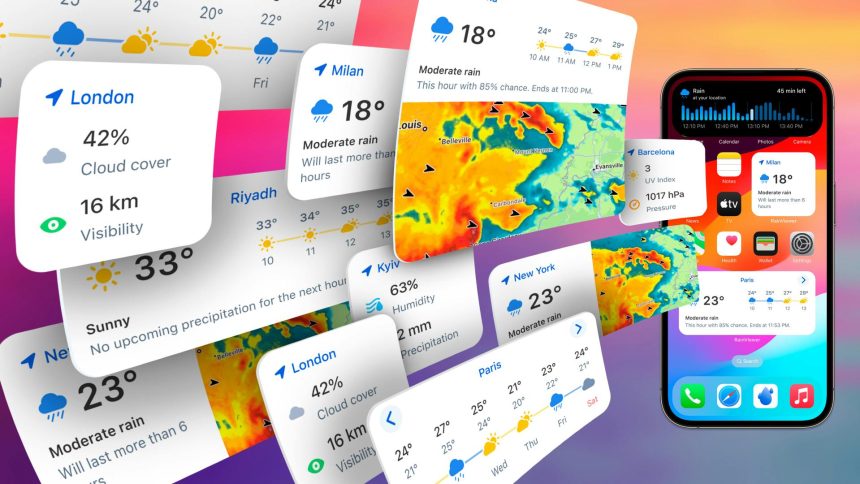
- Nowcast Widget: Displays a minute-by-minute precipitation graph, intelligently switching to an hourly forecast during dry periods.
- Conditions Widget: Provides an immediate snapshot of current weather conditions alongside a short-range forecast.
- Radar Map Widget: Highly customizable, allowing users to choose zoom levels, map layers (such as rain, snow, clouds, or temperature), radar intensity, animation speed, direction, and various overlay options.
- 7-Day Forecast: Essential for users who plan ahead.
- Forecast Summary Widget: Offers a quick glance at today’s highs and lows, precipitation chances, and wind conditions.
- Precipitation Probability Widget: Presents upcoming rain chances hour-by-hour in a compact, easy-to-read format.
- Dynamic Widgets: Enable users to effortlessly switch between multiple favorite locations directly from their home screen, eliminating the need to open the main app.
A key advantage of this system is the ability to configure any widget for any saved location. Users can track four distinct radar views for different cities, or monitor the same location at varying zoom levels—for instance, a regional radar alongside a neighborhood satellite view. All widgets operate seamlessly across these saved locations.
The underlying principle was simple yet profound: if a user needs to open the full application, the widget has not fulfilled its purpose.
Mastering Cross-Platform Optimization
The widgets were built natively for both Android and iOS, carefully respecting each platform’s unique user experience principles while striving for consistent functionality and visual appeal.
On Android, users gained the flexibility to resize widgets, adjust transparency, and create multiple versions for different locations, tailoring their experience precisely.
Despite the inherent system limitations of iOS, the team delivered three radar map sizes, supported dynamic widgets for switching between favorite locations, and enabled users to place multiple widgets for different cities or zoom levels. Users can also resize these widgets and customize their content with the maximum flexibility permitted by the iOS environment.
The Outcome: Widgets That Resonate with Weather Enthusiasts
Since their introduction, these widgets have rapidly become one of the most frequently utilized features within the app. The Android radar widget alone graces over 1.2 million home screens. On average, users interact with these widgets 4 to 6 times daily, effectively transforming them into a personalized dashboard for their local sky.
The project transcended merely building a weather widget. It culminated in the creation of a flexible, data-rich interface designed to foster a deeper understanding of the atmosphere, one effortless glance at a time.
Key Learnings
- Seamless Integration is Key: The most effective widgets feel invisible; users desire instant clarity without conscious thought about the tool itself.
- Server-Side Processing Delivers: For complex data like radar, generating map tiles on powerful remote servers significantly reduces device load and battery consumption.
- User Control Trumps Simplicity: Power users actively seek and value control over their experience, rewarding applications that empower them with extensive customization options.
Looking Ahead
The core objective remains unwavering: to continually make weather tracking smarter, faster, and more engaging for everyone.
Moving forward, the focus extends beyond just building widgets; it’s about engineering an even smarter, more responsive layer that connects people more intimately with the ever-changing atmosphere.
How might these ongoing innovations further transform our daily interactions with weather, making us even more attuned to the world around us?




![Clean Code: Functions and Error Handling in Go: From Chaos to Clarity [Part 1]](https://techtonic.xpansieve.com.ng/wp-content/uploads/2025/10/Clean-Code-Functions-and-Error-Handling-in-Go-From-Chaos-150x150.png)


