

China’s “Agent Hospital”: A Paradigm Shift in AI-Driven Healthcare
The global healthcare landscape is rapidly evolving, driven by unprecedented technological advancements. While digital health solutions and AI-powered diagnostics have become increasingly common, China is taking a monumental leap forward with the advent of the world’s first virtual AI hospital, “Agent Hospital.” This groundbreaking initiative signifies a profound shift towards an “AI-first” model of healthcare delivery, poised to redefine patient care, medical research, and the entire health technology ecosystem.
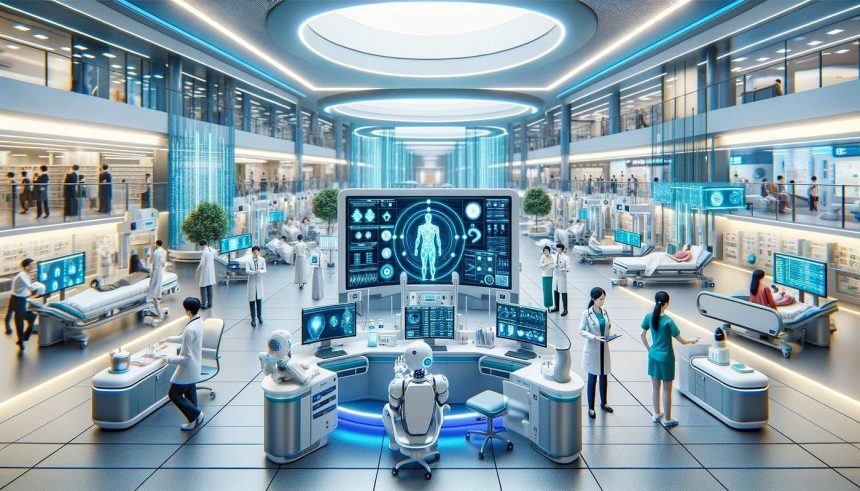
Image: Visualizing the future of AI-driven medical facilities.
The Strategic Imperative: China’s Rise in AI Healthtech
China’s impressive trajectory in AI-first healthcare isn’t accidental; it’s the result of a deliberate, government-backed strategy. Beijing’s proactive legislative framework, spanning national policies and directives from bodies like the Cyberspace Administration of China and the National Medical Products Administration (NMPA), underscores a clear commitment to fostering innovation while safeguarding public well-being.
The COVID-19 pandemic served as a critical accelerator for China’s digital healthcare ambitions. It showcased a successful model where national policy directives seamlessly integrated with private sector implementation, public health responses, and clinical service delivery. Building upon an already robust digital health ecosystem, regulatory guidance and incentives empowered the private sector to contribute significantly to improving healthcare accessibility and quality nationwide. This foundation, combined with the exigencies of the pandemic, fueled an unprecedented demand for AI-driven solutions in areas like initial patient screenings, resource optimization, and telemedicine, a trend further cemented by China’s State Council “Internet + Healthcare” model.
Agent Hospital: A Vision of Autonomous Care
At the vanguard of this revolution is Agent Hospital, an autonomous, self-evolving virtual healthcare environment developed by researchers at Tsinghua University. Powered by advanced large language models, this platform simulates an entire hospital ecosystem, complete with AI patients, nurses, and doctors. Its remarkable capability to diagnose and treat over 10,000 virtual patients in mere days highlights the immense potential for efficiency and scale.
Following internal testing in December 2024, involving Tsinghua University’s AI Industry Research Institute and Chinese AI startup Tairex across more than 20 medical departments, Agent Hospital is slated for a public launch in 2025. A key innovation underpinning this platform is MedAgent-Zero, a design methodology that enables AI doctors to continuously learn and refine their clinical tasks, mimicking human professional development and achieving impressive accuracy in examination, diagnosis, and treatment.
While other AI initiatives, such as Tongji University’s MedGo and Alibaba’s Qwen2.5 Max, are also pushing boundaries in healthcare AI, Agent Hospital distinguishes itself through its comprehensive, holistic virtual environment, demonstrating a broad scope unmatched by many current applications.
A Thriving Ecosystem: Startups and Industry Giants
The clear regulatory framework and government incentives have catalyzed a vibrant AI healthtech ecosystem in China, attracting significant private sector investment and fostering a boom in specialized startups, while also pushing established corporations to maintain their leadership.
Emerging Innovators:
- Chinese AI startup Baichuan pivoted to healthcare in April 2025, focusing on assisting medical professionals in diagnosis and treatment.
- Deepwise, specializing in AI-based clinical imaging for cancer detection, secured $69 million in funding in January 2025.
- Tencent-backed Synyi AI, a provider of smart healthcare solutions, expanded its market presence with undisclosed funding in mid-2024.
- Pioneering companies like Airdoc Technology, which utilizes AI for retina analysis, paved the way, becoming China’s first publicly listed medical AI company in late 2021.
Industry Leaders Pushing Boundaries:
- Ping An Health introduced AI avatars of leading Chinese doctors in March 2025, following its integration of DeepSeek.
- Mindray, a prominent medical device manufacturer, unveiled AI integration via Tencent in its Qiyuan Critical Care Model in December 2024.
- Alibaba was recognized on Fortune’s 2024 Change the World list for its AI tool, which demonstrated superior accuracy over radiologists in detecting pancreatic cancer in non-contrast CT scans.
- Tencent’s HunYuan large language model received significant upgrades in September 2024, enhancing intelligent dialogue, case structuring, and imaging report analysis, building on its earlier integration with social media tools in November 2023.
The Road Ahead: Challenges and Prospects
China’s ambitious strategy for AI in healthcare, epitomized by Agent Hospital and the robust integration of AI across its healthtech sector, positions it as a potential global frontrunner in this transformative domain. The combination of proactive regulatory frameworks, government incentives, and a burgeoning startup ecosystem demonstrates a clear path toward revolutionizing healthcare delivery.
However, the crucial question remains: Can these AI-driven models, especially the concept of fully autonomous AI hospitals, be effectively and safely scaled beyond initial research and development? Addressing critical concerns such as data privacy, mitigating algorithmic bias, ensuring adequate human oversight in complex clinical scenarios, and seamlessly integrating AI into existing, often fragmented, healthcare infrastructures will be paramount.
As China continues to explore the frontiers of AI in medicine, the world will undoubtedly watch to see if its bold vision for AI-first healthcare can not only scale but also set a new global standard for healthtech innovation. What ethical and societal implications will arise as AI increasingly takes on roles traditionally reserved for human medical professionals?




![Clean Code: Functions and Error Handling in Go: From Chaos to Clarity [Part 1]](https://techtonic.xpansieve.com.ng/wp-content/uploads/2025/10/Clean-Code-Functions-and-Error-Handling-in-Go-From-Chaos-150x150.png)


