

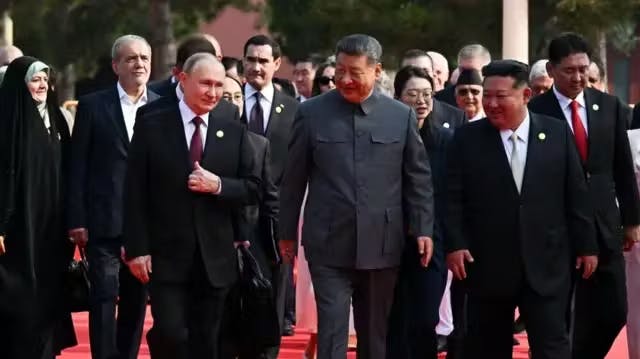
The Converging Shadows: How Beijing and Moscow Accelerate a Technologically Empowered Authoritarian Bloc
Russia’s full-scale invasion of Ukraine has done more than just destabilize the international order; it has deepened a strategic, technological partnership between Moscow and Beijing, extending its influence across a growing axis of authoritarian states including North Korea, Iran, and Venezuela. This emerging bloc, far from being a collection of disparate actors, is demonstrating a chilling level of strategic alignment, sharing military technology, battlefield lessons, and economic support to collectively challenge Western dominance and advance a vision of an autocracy-led world.
Ukraine: A High-Stakes Training Ground for Authoritarian Innovation
The ongoing conflict in Ukraine is serving as a critical testing ground, providing invaluable modern warfare experience that is being meticulously observed and integrated by Russia and its partners. North Korea, for instance, has reportedly committed an estimated 15,000 troops to the front lines, suffering significant casualties. Despite initial heavy losses, Ukrainian intelligence notes their rapid adaptation to drone warfare, small-group tactics, and defensive strategies against modern systems. This unprecedented battlefield exposure is directly informing Pyongyang’s 1.3 million-strong army, enhancing its capabilities in ways previously unimaginable.
Beyond manpower, North Korea has emerged as a vital arms supplier for Russia, reportedly furnishing up to 40% of Moscow’s artillery needs. In a reciprocal exchange, Moscow is bolstering Pyongyang’s military-industrial complex, providing capabilities for mass-producing Shahed-style kamikaze drones and even sharing advanced nuclear submarine technology. Such a transfer of sensitive technology could drastically escalate regional threats. Moreover, Ukrainian intelligence suggests that up to 20,000 North Korean workers are engaged in Russian military production, particularly in drone manufacturing, directly supporting Moscow’s war effort.
The Drone Proliferation: A Web of Cooperation
The drone has become a central pillar of this new axis’s technological synergy. Iran played a foundational role in establishing Russia’s Shahed drone production capabilities, transforming these relatively cheap, effective strike drones into a devastating mainstay of Russian attacks on Ukrainian cities. These systems are now being integrated with Chinese GPS equivalents, enhancing their resistance to jamming and improving targeting accuracy.
Venezuela, once a marginal player in Latin American defense, has rapidly evolved into a sophisticated drone producer, fielding Iranian-designed strike drones through covert cooperation with Tehran. Alarmingly, pro-Kremlin channels have even suggested sending Russian Geran drones to Venezuela, claiming they could target US bases in the Caribbean and potentially reach the US mainland. This audacious expansion of threat projection underscores the deepening military-technological ties. This assistance isn’t confined to the Ukraine theater; Moscow has also provided critical satellite targeting data to Yemen’s Houthi rebels, enabling them to strike commercial shipping in the Red Sea.
China’s Pivotal Role: Powering the Axis from Behind the Scenes
China’s contribution to strengthening this authoritarian alignment is extensive and multifaceted, often operating with a degree of strategic ambiguity. Ukrainian President Volodymyr Zelenskyy has warned that Beijing has effectively cut off critical drone supplies to Ukraine while keeping the pipeline wide open for Moscow. Reports indicate Chinese representatives have even been present at Russian drone production lines, and Chinese military officers observed on the front lines, undoubtedly studying modern warfare tactics with Beijing’s implicit approval.
Perhaps most critically, Kyiv’s intelligence services allege that China is providing Russia with satellite reconnaissance data to help guide missile strikes on Ukraine, including against facilities owned by foreign companies. This “high-level cooperation” in satellite intelligence was notably evident during a massive Russian missile and drone strike on October 5th, where at least three Chinese reconnaissance satellites flew over western Ukraine—a primary target of the assault.
Economically, China is directly supplying a vast array of critical components and equipment to Russia’s military-industrial complex. This includes machine tools, special chemicals, gunpowder, and other essential components to some 20 Russian military factories. By early 2025, an estimated 80% of critical drone electronics found in Russian systems were of Chinese origin. Reuters reported that Chinese drone experts have even collaborated directly with sanctioned Russian arms maker IEMZ Kupol to develop new models. Conversely, leaked Russian documents suggest Moscow is sharing equipment and training with Beijing that could accelerate China’s airborne capabilities by a decade or more, indicating a two-way flow of critical military technology.
A Unified Threat Demands a Unified Response
The evidence overwhelmingly points to a profoundly interconnected “axis” where technology, battlefield experience, and strategic resources are freely exchanged. As an expert from Ukraine-focused venture capital firm Green Flag Ventures noted, “Every day in Ukraine, equipment is recovered with Chinese components – not just frames, but chips and systems. Russia and China are clearly sharing technology.” This dynamic stands in stark contrast to the often-debated and slow-moving military aid processes of democratic nations.
These authoritarian regimes are not merely engaging in transactional dealings; they are collectively learning and advancing their military capabilities through real-world conflict, exploiting every opportunity to refine their tactics and technologies. The longer this war persists, the more profound the lessons absorbed by Moscow and subsequently transferred to its partners, creating a cycle of continuous improvement. The West’s tendency to treat these flashpoints as isolated conflicts dangerously overlooks the strategic depth and unified trajectory of this collaboration.
Unless democratic nations recognize and confront this growing authoritarian axis as a unified, technologically strengthening threat, they risk facing a much more formidable and coordinated challenge down the line. The stakes are global, extending far beyond the borders of Ukraine.
How long can the international order withstand the relentless, coordinated technological advancements of this increasingly integrated anti-Western bloc?




![Clean Code: Functions and Error Handling in Go: From Chaos to Clarity [Part 1]](https://techtonic.xpansieve.com.ng/wp-content/uploads/2025/10/Clean-Code-Functions-and-Error-Handling-in-Go-From-Chaos-150x150.png)


