

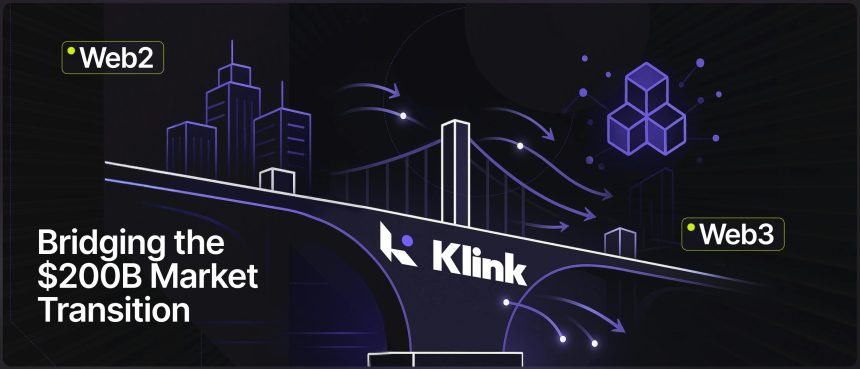
The digital advertising landscape, a colossal $200 billion industry, is undergoing a seismic shift. Amidst regulatory tightening, privacy concerns, and diminishing returns for traditional Web2 models, a new breed of platforms is emerging. At the forefront of this promised transition is Klink Finance, which has boldly announced its intention to capture a significant share of this migrating market with the October 2025 launch of its $KLINK utility token. But is Klink poised to be a true pioneer, or does its vision face formidable hurdles in the complex Web3 frontier?
The Crumbling Pillars of Web2 Advertising
For years, Web2 intermediaries have dominated digital advertising, often extracting substantial value while offering minimal, if any, compensation to the users whose attention and data fuel the entire ecosystem. This model is now under unprecedented strain:
- Regulatory Onslaught: Measures like Apple’s App Tracking Transparency (ATT) and Google’s impending cookie deprecation have fundamentally disrupted traditional attribution methods, forcing advertisers to seek more transparent and verifiable alternatives.
- Economic Inefficiency: Customer acquisition costs are spiraling, with a reported 25% annual increase, while conversion rates stubbornly decline. Even Web3 platforms often spend hundreds per user with low conversion to active participants.
- User Disenfranchisement: The prevailing model monetizes user engagement without direct reciprocity, leading to growing calls for fairer participation and compensation.
This confluence of factors has created a fertile ground for Web3 solutions, with industry projections anticipating Web3 advertising spend to surge to $300 billion by 2030, driven by the adoption of blockchain-based attribution, direct user compensation, and tokenized incentives.
Klink’s “First-Mover” Stance: Reality or Rhetoric?
Klink Finance asserts a “two-year head start,” claiming to have deployed operational infrastructure while competitors are still in the theoretical phase. Their reported metrics include a robust user base of over 900,000 registered users across 140 countries, augmented by 5.2 million additional users via API partner integrations. The platform also boasts commercial validation from 500+ global advertisers, processing over $50,000 weekly in automated payouts, and having distributed more than $1 million to users. These figures, while impressive for an early-stage Web3 project, represent a fraction of the $200 billion market they aim to penetrate, prompting questions about the scalability and sustained growth needed to meet such ambitious targets.
Strategic partnerships with major players like Bybit, Coinbase, Crypto.com, Arbitrum Foundation, XDC Network, Wirex, Binance, and Ledger lend significant credibility. However, the nature and depth of these partnerships – whether they involve deep integrations, joint ventures, or mere ecosystem participation – will be critical in determining Klink’s true leverage and reach within these established networks.
The Technical Blueprint for Transition
Klink’s platform architecture is designed to bridge the Web2-to-Web3 divide, emphasizing technical flexibility and operational efficiency:
- Multi-Chain Compatibility: Ensuring seamless integration across various blockchain networks to simplify the transition for Web2 advertisers.
- API-First Design: Enabling rapid embedding of Klink’s offer infrastructure into third-party platforms, facilitating instant monetization and aligned stakeholder incentives.
- Automated Processing: Handling campaign management, fraud detection, and multi-currency payment processing across 140 countries, aiming for enterprise-grade efficiency.
- Attribution Transparency: Utilizing blockchain for immutable records of user journeys, addressing one of Web2’s growing pain points.
- Hybrid Payment Rails: Supporting both cryptocurrency and traditional fiat, reducing adoption friction for migrating advertisers.
The $KLINK Utility Token: A 2025 Catalyst
The much-anticipated October 2025 launch of the $KLINK utility token is positioned as the linchpin of Klink’s ecosystem. The token is designed to drive demand through several mechanisms:
- Advertiser Spending: All campaign expenditures are slated to flow through $KLINK, whether directly paid in crypto or automatically converted from fiat, creating a consistent demand tied to advertiser budgets.
- User Incentives: Staking $KLINK is promised to unlock up to 40% higher payouts and exclusive platform access, incentivizing user retention and participation.
- B2B Access: Commercial partners will acquire $KLINK for advertising credits and premium API features.
The decision to launch the token in October 2025, nearly two years after this announcement, raises an interesting strategic question. While it allows ample time for ecosystem development and further validation of their existing infrastructure, it also prolongs exposure to market volatility and potential shifts in the competitive landscape. It suggests a patient, long-term vision, but one that must sustain momentum and investor confidence over an extended period.
Market Positioning and Investor Confidence
Klink Finance enters this market amidst converging favorable conditions: increasing enterprise allocation to Web3 user acquisition, maturing blockchain technology, and an economic climate driving demand for supplemental income opportunities. The company has garnered significant investor backing from institutions such as Castrum Capital, Blockchain Founders Fund, UOB Ventures, Master Ventures, Signum Capital, and Taisu Ventures, alongside grant support from the Arbitrum Foundation. This institutional confidence underscores a belief in Klink’s operational execution beyond mere theoretical potential.
The Road Ahead: Expansion and Evolution
Following the token launch, Klink’s post-launch strategy focuses on:
- Geographic Expansion: Targeting underserved regions with multi-language support (15+ languages) and localized payment options.
- Enterprise Tools: Developing a self-serve advertiser portal and advanced analytics to cater to large-scale migrations.
- API Ecosystem Growth: Expanding the commercial Offer API to embed Klink’s infrastructure across more platforms, fostering network effects.
- Advanced Features: Integrating AI-powered optimization, on-chain attribution, and enhanced fraud prevention to maintain a competitive edge.
A Vision for a Fairer Ad Economy, or a Glimpse of the Challenges?
Klink Finance presents a compelling case for a more equitable and transparent advertising model, demonstrating early success with user engagement and profitable unit economics. Their operational history and strategic partnerships position them as a serious contender in the Web3 ad tech space. However, the true test lies in scaling these initial achievements to meaningfully impact a $200 billion market, managing the complexities of a protracted token launch timeline, and fending off inevitable competition.
As the digital advertising industry marches towards an increasingly decentralized future, Klink Finance’s journey will serve as an intriguing case study. Can its blend of proven infrastructure and tokenized incentives truly recalibrate the economics of advertising, delivering sustainable value to all stakeholders, or will the ambitious promises of Web3 advertising prove more challenging to fully realize at scale?




![Clean Code: Functions and Error Handling in Go: From Chaos to Clarity [Part 1]](https://techtonic.xpansieve.com.ng/wp-content/uploads/2025/10/Clean-Code-Functions-and-Error-Handling-in-Go-From-Chaos-150x150.png)


