

In the realm of rapid-response operations, the true measure of a piece of equipment’s readiness isn’t its spec sheet, but its deployability. Can it be shipped on a Tuesday and fully operational by Friday? This straightforward question defines true field readiness. Over the past year, significant efforts have gone into developing rapid-deploy gateway vehicles for volunteer teams and agile agencies. The most successful designs share a common DNA: they are inherently modular, intensely practical, and incredibly simple to configure.
This article delves into a hands-on, experience-driven approach for constructing a solar-powered LoRa vehicle gateway. The goal is a system that can be assembled in a single day, thoroughly tested over a weekend, and compactly crated for swift shipping. This blueprint emerges from real-world trials, including roadside antenna swaps in the drizzle and fuse replacements under headlamps. The core philosophy is clear: when moving hardware quickly, prioritize design for the field, not for theoretical specifications.
Strategic Design Imperatives
Effective design starts with understanding the demands of real-world scenarios:
- Achieve deployment by a single operator within 30 minutes.
- Ensure autonomous off-grid operation for a minimum of 48 hours under typical usage.
- Guarantee resilience against rain, dust, and minor impacts.
- Consolidate into a single, padded crate for streamlined transport.
- Utilize widely available, inexpensive components to facilitate easy replacement.
Designs meeting these criteria will empower operational teams. Neglecting them often leads to improvised, suboptimal workarounds becoming entrenched fixtures.
Essential Hardware Configuration
A practical list of components critical for deploying a capable gateway expeditiously includes:
- A robust vehicle rack or magnetic mount plate, engineered to withstand vibrations.
- A LoRa gateway module with USB or Ethernet backhaul, supporting a 9 to 24 V external power input.
- A compact single-board computer (e.g., Raspberry Pi) for gateway management and local application hosting.
- A solar panel, 60 to 120 W, featuring an IP65 junction box. Sizing depends on daily power consumption and local solar irradiance.
- A Maximum Power Point Tracking (MPPT) charge controller, ideally with configurable battery chemistry profiles.
- A 12 V lithium battery pack, sized for 48 hours of operation with a generous safety margin, complete with a Battery Management System (BMS) and fuse.
- A collapsible roof mast, 1 to 2 meters in height, designed for easy shipping with quick-release mounts.
- Antennas: an omnidirectional antenna for broad coverage and a small yagi for directed links. Quick-connectors like N-type male/female are essential for rapid swaps.
- A weatherproof enclosure for electronics, equipped with cable glands and an internal mounting plate.
- A compact field toolkit: short coaxial cables, T-connectors, dielectric grease, spare fuses, and zip ties.
- A comprehensive documentation packet, both printed and on a USB stick, including network credentials, wiring diagrams, and recovery instructions.
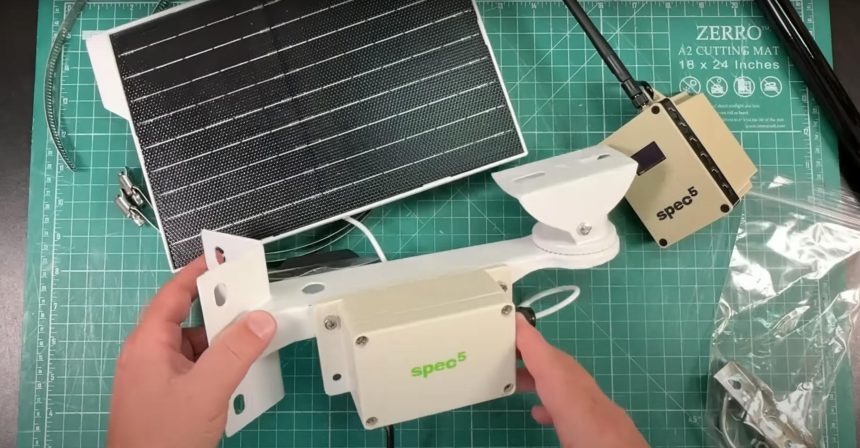
It’s worth noting that specific rugged, drop-in gateway units, such as the SpecFive Voyager, have proven effective in field trials due to their splash resistance and magnetic mounting. The emphasis remains on modularity and avoiding vendor lock-in, treating such units as just one more component in a flexible system.
Assembly and Integration Protocol
The development process typically involves bench-prototyping followed by production-crate assembly:
- Securely mount the gateway and single-board computer onto the internal plate using lock washers.
- Wire the MPPT output to the battery’s BMS, then run a fused feed to the electronic components, meticulously labeling every wire.
- Install the antenna mast, ensuring clean connector mating. Apply a thin layer of dielectric grease to all outdoor connectors.
- Load the operating system image, configure the gateway service, and pre-bake essential scripts for logging and remote health checks.
- Conduct a 4-hour soak test under anticipated load conditions, logging voltage, CPU temperature, and packet counts.
- Upon successful soak test completion, power down the unit and pack it with shock-absorbing foam, including a clear build sheet.
The build sheet is paramount, detailing wire runs, serial numbers, and a concise troubleshooting tree to guide technicians to relevant fuses, cables, or log files.
Packaging for Field-Readiness
To ensure hardware arrives intact and functional, packaging must consider both shipping logistics and field mechanics:
- Utilize a double-wall crate or a reusable flight case with custom internal foam cutouts, specifically cradling mast sections to prevent bending.
- Keep sensitive electronics grouped together, and batteries in a separate, clearly labeled bag with handling instructions, adhering strictly to lithium battery shipping regulations.
- Affix a laminated quick-start guide to the inside lid, enabling immediate setup without manual hunting.
- Include a small, field-proof parts kit: N-type male to SMA adapters, a multimeter, spare fuses, and a miniature screwdriver set.
A real-world example highlights this necessity: a crate once arrived with a bent mast section, causing a 48-hour delay. However, the inclusion of a spare mast tube and the correct connectors allowed the team to get the gateway operational within an hour of arrival.
Remote Management and Diagnostics
Pre-provisioning devices as much as security policies allow is crucial. At a minimum, automate the following:
- A startup script that transmits a heartbeat to a designated endpoint within five minutes of boot.
- A log rotation and upload process focused solely on health metrics, avoiding unauthorized bulk telemetry or raw packet capture data.
- An automatic fallback mechanism that establishes a reverse SSH tunnel when permitted, allowing remote engineers direct access without complex VPN configurations.
Implement staged and reversible remote updates. A new image push should retain the previous partition for at least one boot cycle, enabling remote rollback if issues arise.
On-Site Activation Checklist
Train the receiving team on a concise, six-item checklist for initial deployment:
- Mount the mast and visually confirm its physical integrity.
- Connect the solar panel and verify the MPPT reports active charging.
- Check battery voltage and the BMS state.
- Power the gateway and confirm its heartbeat is visible on the control plane.
- Verify antenna orientation. A brief 30-second walk test with handheld nodes is often more informative than extensive log analysis.
- Record the device serial number and initial RSSI values.
If the heartbeat isn’t observed on the control panel within 10 minutes, refer to the laminated troubleshooting guide. If that fails, contact the designated operations support number, ensuring the contact list within the crate is current.
Pre-Shipment Quality Assurance
Before sealing the crate, run these swift tests, typically taking less than an hour:
- Power Failure Test: Cut vehicle power and confirm the battery sustains the gateway for at least 15 minutes.
- Solar Simulation Test: Simulate low light conditions and confirm the MPPT reports limited charge without oscillation.
- Network Connectivity Test: Send a test packet to the cloud ingest and verify its successful receipt.
- Thermal Stress Test: Place the enclosure in a 40-degree Celsius environment for 30 minutes and monitor CPU and gateway temperatures.
These tests are designed to catch simple, yet critical, failures that can derail field operations.
Reflections on Robust Deployment
Designing for speed is not about cutting corners, but about facilitating rapid, inexpensive iterations. Keep spare parts affordable and easy to ship. Document every aspect of the build and any failure modes encountered. Treat the receiving field team as an invaluable QA partner, equipping them with the tools needed to resolve minor issues quickly.
Shipping hardware fast is a testament to solid design, consistent processes, and judicious component selection. A crate containing a well-documented, thoroughly tested, modular gateway that withstands rain, vibration, and even a less-experienced operator signifies success. If your hardware can be dispatched on a Tuesday and be online by Friday, you’ve truly built for the realities of the operational world.
What further innovations could streamline the “last mile” of hardware deployment, transforming complex setups into truly plug-and-play experiences?




![Clean Code: Functions and Error Handling in Go: From Chaos to Clarity [Part 1]](https://techtonic.xpansieve.com.ng/wp-content/uploads/2025/10/Clean-Code-Functions-and-Error-Handling-in-Go-From-Chaos-150x150.png)


