

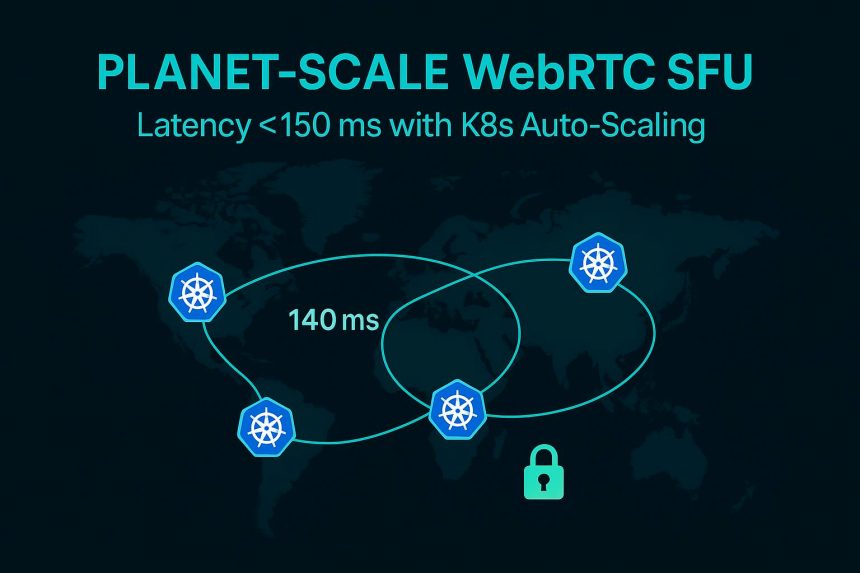
In the rapidly evolving world of real-time communication, delivering seamless, low-latency video across vast geographic distances presents a formidable challenge. A leading global live-streaming platform has recently unveiled a groundbreaking solution: a planet-scale WebRTC Selective Forwarding Unit (SFU) built on Amazon Web Services (AWS) using Kubernetes, achieving an impressive end-to-end latency below 150 milliseconds (with a P95 of 140ms).
This achievement is not just a technical marvel; it represents a crucial advancement for any service demanding real-time interactivity. The core of their strategy hinges on a distributed architecture that leverages AWS’s global infrastructure, intelligent DNS routing, sophisticated autoscaling, and rigorous resilience testing.
The Global Latency Problem: Why Single-Region Architectures Fail
The conventional approach of hosting a WebRTC SFU in a single geographic region quickly falters when users span continents. The fundamental issue is round-trip time (RTT). A call between, say, Australia and a US-based SFU can easily incur over 200 milliseconds of RTT before any media processing even begins. This inherent delay, when combined with even minor packet loss, severely degrades video quality, leading to noticeable freezes and a user experience far exceeding acceptable latency targets.
- Distance-Induced Delay: Every additional kilometer between a user and the SFU contributes to two-way propagation delays. A mere 100ms one-way latency translates to 200ms RTT before media transmission starts.
- Packet Loss Amplification: High-RTT links are notoriously prone to jitter and packet loss. Even a seemingly small 1-2% packet loss can drastically reduce video throughput on long-distance paths, forcing retransmissions or causing visual glitches.
- Exorbitant Bandwidth Costs: Concentrating all global traffic into a single data center incurs substantial cross-region data transfer fees and internet egress charges from AWS, alongside NAT Gateway processing fees. This makes a single-region model economically unsustainable at scale.
The conclusion is clear: for truly global, low-latency WebRTC, a distributed, multi-region SFU architecture is not just beneficial, but essential for performance, resilience, and cost efficiency.
A Multi-Regional Blueprint for Global Performance
To overcome the limitations of a single-region setup, the engineering team deployed a multi-region Kubernetes architecture. This design places identical SFU deployments in Amazon EKS clusters across various major AWS geographic regions (e.g., us-east-1, eu-central-1). This strategic distribution provides critical redundancy and local presence, ensuring users connect to the nearest available SFU.
The routing mechanism is ingeniously designed:
- Route 53 Latency-Based DNS: When a client attempts to connect, Amazon Route 53, leveraging its global network metrics, resolves the application domain to the IP address of the closest healthy regional SFU cluster. This intelligent routing ensures optimal initial connection latency.
- Geo-Sticky JWTs: To maintain session consistency and prevent clients from being re-routed by subsequent DNS queries, a “geo-sticky” JSON Web Token (JWT) is issued upon login. This JWT embeds the client’s assigned region, ensuring all subsequent reconnections or signaling traffic consistently targets the same regional SFU cluster.
- WebRTC Handshake: Once routed, the standard WebRTC handshake proceeds. This involves Interactive Connectivity Establishment (ICE) for peer-to-peer connection setup, followed by Datagram TLS (DTLS) handshakes to secure the media transport via Secure Real-time Transport Protocol (SRTP). This sequence, adhering to RFC 8827, ensures that all audio and video streams are securely encrypted from end-to-end.
Intelligent Autoscaling: Meeting Demand with Precision
Achieving sub-150ms latency at scale demands a highly responsive autoscaling mechanism. The platform implemented a sophisticated dual-layer autoscaling strategy for its SFU pods:
- Horizontal Pod Autoscaler (HPA) with Custom Metrics: For steady-state load management, Kubernetes HPA scales pods based on a custom metric:
outboundVideoTracks. This metric precisely counts the number of video streams an SFU pod is actively forwarding. By monitoring this custom metric via Prometheus or CloudWatch, the HPA controller dynamically adjusts the replica count to match demand. This allows for fine-grained control and efficient resource utilization, with capacity planning formulas guiding the scaling, such as calculating the number of pods needed based on bitrate, peers, and SFU CPU capacity. - KEDA for Burst Scenarios: To handle sudden, unpredictable surges in traffic—like a rapid influx of participants into a conference call—the Kubernetes Event-driven Autoscaler (KEDA) is employed. KEDA monitors event streams (e.g., the rate of new WebSocket connections) and can trigger aggressive, step-based scaling. For instance, by observing the lag in a Kafka topic processing new signaling events, KEDA can quickly provision multiple new SFU pods, ensuring instant capacity for traffic spikes.
This combined approach of HPA for gradual adjustments and KEDA for rapid bursts ensures the SFU infrastructure remains agile, providing consistent performance even under the most demanding load profiles.
Resilience Under Pressure: The Chaos Engineering Advantage
True robustness is proven under adversity. The team rigorously tested their SFU’s resilience by injecting network “chaos” directly into SFU pods’ interfaces using Linux’s tc (traffic control) netem. This involved introducing 200ms of delay and 2% packet loss, simulating extremely challenging network conditions. These real-world scenarios are often the undoing of lesser systems.
Under these simulated adverse conditions, the SFU performed remarkably. CPU usage on individual pods rose modestly, from a baseline of ~20% to ~60%, indicating significant headroom. Critically, the P95 latency, while increased, remained under the target 150ms, a testament to the SFU’s built-in buffering and Forward Error Correction (FEC). Unlike a traditional software MCU which might have experienced timeouts or severe freezes, the SFU gracefully handled retransmissions and only marginally increased jitter (P90 jitter rose from 10ms to 50ms). This validated the SFU’s robust code paths and concurrency handling, with no observed drops or crashes.
Fortifying the Fortress: Security and Compliance
Security is paramount in real-time communication. The platform implemented a multi-layered security strategy:
- End-to-End DTLS-SRTP Encryption: All WebRTC media streams are mandated to use DTLS-SRTP encryption, with DTLS keying SRTP per RFC 8827. This ensures that video and audio content is encrypted from the client to the SFU and back, protecting user privacy.
- Mutual TLS (mTLS) for Internal Traffic: All inter-node and control plane communication between SFU pods and other microservices is secured with mutual TLS. This means internal endpoints verify each other’s certificates, preventing unauthorized access within the cluster.
- Private Application Load Balancers (ALBs): No SFU pod is directly exposed to the public internet. All Kubernetes ingress points utilize private ALBs with HTTPS, creating a secure boundary around the internal network.
- Automated Certificate Management: TLS certificates are centrally managed via AWS Certificate Manager or cert-manager, with automated rotation to ensure certificates are always current and alarms in place for impending expirations.
- Compliance Controls: For regulatory compliance (e.g., GDPR, HIPAA), access and metrics are logged to encrypted CloudWatch Logs, and network ACLs and Security Groups are used to isolate clusters effectively.
This comprehensive security posture ensures data integrity and confidentiality across the entire system.
Beyond Compute: The Cost Efficiency of Distribution
While a multi-region setup introduces some additional overhead (extra EKS clusters, control plane instances, and NAT gateways per region), the economic benefits, particularly concerning data transfer costs, are overwhelmingly positive. In a single-region setup, intercontinental streams incur significant cross-region and public internet egress charges. Furthermore, NAT Gateway processing fees (typically ~$0.045/GB in the US) add up quickly.
By implementing geo-sharding, approximately 70% of media traffic remains localized within its region. This localization resulted in a dramatic ~70% reduction in global data egress spending. For example, routing European users to an EU region eliminated a substantial portion of transit costs and associated NAT charges. Although multi-region deployment means slightly higher EC2/EKS costs due to redundant idle pods, the strategic use of spot instances for worker pods (saving ~50%) and aggressive downscaling during off-peak hours effectively offsets this. Ultimately, the immense savings on inter-region bandwidth costs far outweigh the increased VM expenses for a large, global user base, resulting in a significantly lower total monthly spend.
Future Horizons & Key Learnings
The journey of building a planet-scale SFU yielded several invaluable lessons:
- Early Chaos Testing is Crucial: Proactively injecting delay and packet loss into the network stack uncovers bottlenecks and ensures resilience in real-world, often unpredictable, network conditions.
- Stateless Data Plane for Failover: Designing SFU pods to be stateless across regions simplifies failover and prevents cross-region state synchronization complexities, enhancing system robustness.
- Conservative Autoscaling for Stability: Over-provisioning slightly to absorb initial traffic bursts prevents “hot-start” latency and ensures a smoother user experience during rapid demand changes.
Looking ahead, the platform is exploring several innovations. Experimentation with QUIC (HTTP/3) as a WebTransport backend promises further reductions in handshake overhead and improved performance over lossy links. Implementing dynamic SVC (Scalable Video Coding) layer adaptation on the SFU will allow for smarter content delivery, letting clients subscribe to multiple quality layers based on their network conditions. Finally, WebTransport (an IETF draft) is being considered as a replacement for WebSocket for signaling and data, potentially reducing overhead further. Continuous monitoring via CloudWatch, refinement of scaling formulas, and integration of new WebRTC features will drive ongoing performance and efficiency improvements.
The success of this planet-scale WebRTC SFU demonstrates that achieving ultra-low latency for global real-time video is not just a dream, but an achievable reality through thoughtful architecture and diligent engineering. As live streaming and interactive video continue to shape our digital interactions, what new frontiers will this level of low-latency performance unlock for truly immersive global experiences?




![Clean Code: Functions and Error Handling in Go: From Chaos to Clarity [Part 1]](https://techtonic.xpansieve.com.ng/wp-content/uploads/2025/10/Clean-Code-Functions-and-Error-Handling-in-Go-From-Chaos-150x150.png)


