By using this site, you agree to the Privacy Policy and Terms of Use.
Accept
Sign In
TechTonicTechTonicTechTonic
Notification Show More
Font ResizerAa
  • Home Technology
    • Home 2Hot
    • Home 3
    • Home 4
    • Home 5New
  • Technology
    Technology
    Modern technology has become a total phenomenon for civilization, the defining force of a new social order in which efficiency is no longer an option…
    Show More
    Top News
    Apple Jul Announcement: What a Refresh for Macbook
    Sponsored by
    Sponsored by
    Advantages and Disadvantages of Having Smartphone
    December 8, 2021
    Top 10 Best Portable Bluetooth Speakers for Summer Fun
    December 9, 2021
    Latest News
    The Invisible Architect: Why Human Thought Drives True Automation
    October 30, 2025
    The Groundhog Day of AI: When Your Automated Content Just Can’t Get It Together
    October 22, 2025
    Unmasking AI’s Blind Spot: Why “Later” Matters for Language Model Authority
    October 20, 2025
    Beyond the Brain Drain: Why Smart People Reuse Passwords and What Actually Works
    October 15, 2025
  • Gadget
    GadgetShow More
    The History and Future of CAD in Engineering
    From Drafting Boards to Digital Minds: The Transformative Journey of CAD and Its AI-Powered Horizon
    5 Min Read
    The Seven-Step Hostage Situation You Call Onboarding
    Investigating the Onboarding Blunder: When Helping Becomes a Hostage Situation
    12 Min Read
    Why Over-Caching Can Be Just as Bad as No Caching
    Beyond Optimization: Unmasking the Dangers of Excessive Caching
    9 Min Read
    Why SaaS Pricing Pages Fail
    Decoding Disappointment: An Investigation into SaaS Pricing Page Ineffectiveness
    10 Min Read
    Turning the Compiler Into Your Co-Architect
    Architecting Software with the Compiler: Enforcing Contracts Through Type Systems
    16 Min Read
  • Posts
    • Post Layouts
      • Standard 1
      • Standard 2
      • Standard 3
      • Standard 4
      • Standard 5
      • Standard 6
      • Standard 7
      • Standard 8
      • No Featured
    • Gallery Layouts
      • Layout 1
      • Layout 2
      • Layout 3
    • Video Layouts
      • Layout 1
      • Layout 2
    • Audio Layouts
      • Layout 1
      • Layout 2
      • Layout 3
    • Post Sidebar
      • Right Sidebar
      • Left Sidear
    • Content Features
      • Inline Mailchimp
      • Highlight Shares
      • Print Post
      • Inline Related
    • Auto Load Next Posts
    • Sponsored Post
  • Pages
    • Search Page
    • 404 Page
Reading: MySQL’s ENUM and SET: A Deep Dive into Efficient Data Handling and Hidden Pitfalls
Share
TechTonicTechTonic
Font ResizerAa
  • Tech News
  • Gadget
  • Technology
  • Mobile
Search
  • Home
    • Home 1
    • Home 2
    • Home 3
    • Home 4
    • Home 5
  • Categories
    • Tech News
    • Gadget
    • Technology
    • Mobile
  • Bookmarks
  • More Foxiz
    • Sitemap
Have an existing account? Sign In
Follow US
  • Contact
  • Blog
  • Complaint
  • Advertise
© 2022 Foxiz News Network. Ruby Design Company. All Rights Reserved.
data-sciencedatabasesdatabases-best-practicesenumhackernoon-top-storymysqlmysql-data-typesset-types

MySQL’s ENUM and SET: A Deep Dive into Efficient Data Handling and Hidden Pitfalls

AgentKyles
Last updated: July 16, 2025 3:38 am
AgentKyles
Share
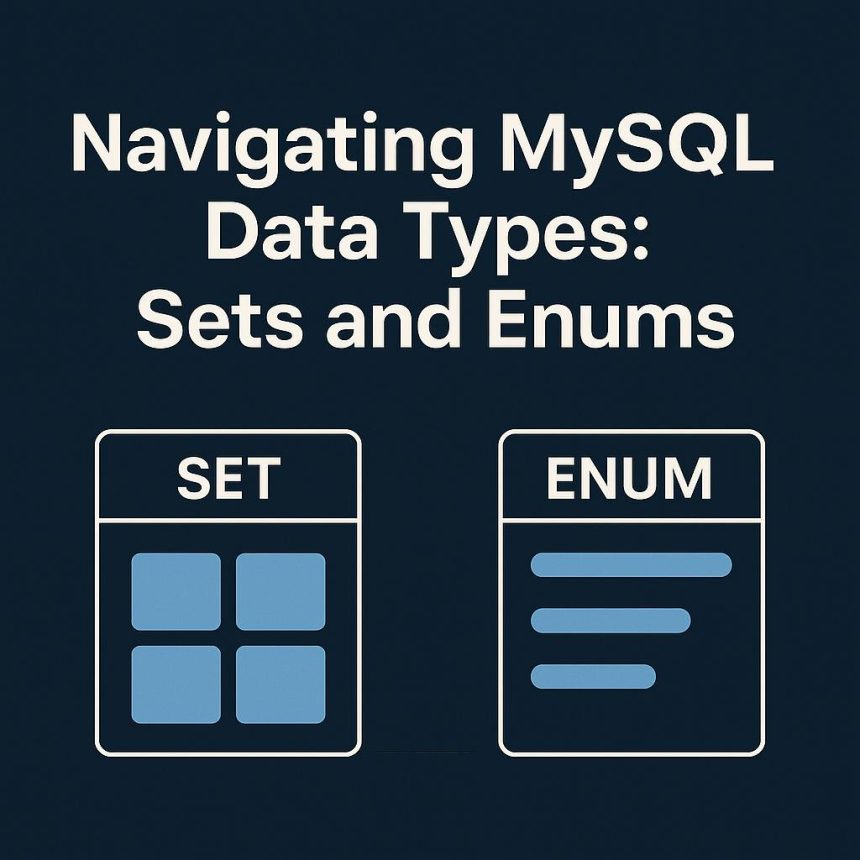
Navigating MySQL Data Types: Sets and Enums
SHARE

Introduction: Specialized Types in MySQL

In the vast landscape of MySQL data types, SET and ENUM stand out as specialized tools for managing constrained lists of data. While they offer undeniable convenience and can significantly enhance schema readability, their internal mechanics and behavior can introduce subtle complexities. This article delves into the intricacies of these types, exploring their core functionality, common usage patterns, and, crucially, the pitfalls that can turn a seemingly straightforward design choice into a data integrity headache. Our aim is to equip you with the knowledge to leverage their power effectively while sidestepping their notorious traps.

Contents
Introduction: Specialized Types in MySQLDeconstructing ENUM and SET: What They Are and How They WorkSyntax and Practical ExamplesNavigating the Minefield: Common Pitfalls and Expert CountermeasuresThe Schema Evolution Trap: ENUM ReorderingThe Collation Conundrum: String vs. Numeric SortingStricter Modes and ValidationSET LimitationsConclusion

Deconstructing ENUM and SET: What They Are and How They Work

At their core, both ENUM and SET are string objects that impose strict limitations on the values they can hold. However, their fundamental difference lies in the number of selections allowed from a predefined list:

  • ENUM (Enumeration): An ENUM column can store a single value chosen from a predefined list of strings. Think of it as a multiple-choice question where only one answer is correct.
    • Example Use Case: Defining the status of an order (e.e., ‘pending’, ‘paid’, ‘shipped’, ‘cancelled’).
    • Internal Storage: Crucially, MySQL stores ENUM values as tiny integers, mapping each string in the list to a 1-based index. This integer-based storage makes ENUM efficient in terms of disk space and allows for faster internal processing compared to a variable-length string.
    • Capacity: It can support up to 65,535 distinct elements, mirroring the range of a SMALLINT.
  • SET: A SET column allows for storing any combination of values from a predefined list. This is akin to checkboxes where multiple options can be selected.
    • Example Use Case: Assigning user permissions (e.g., ‘read’, ‘write’, ‘delete’). A user could have ‘read’ and ‘write’ permissions simultaneously.
    • Internal Storage: SET values are internally stored as a bitmap or bitmask. Each element in the predefined list corresponds to a specific bit position. If a value is present in the SET, its corresponding bit is set to 1; otherwise, it’s 0. This bitwise representation is remarkably efficient for storing combinations.
    • Capacity: Due to its bitmask nature, SET is limited to a maximum of 64 distinct elements, corresponding to the capacity of a BIGINT (64-bit integer).

Syntax and Practical Examples

Implementing ENUM and SET is straightforward in your SQL schema:

ENUM Example: Order Status

CREATE TABLE orders (
    id INT AUTO_INCREMENT PRIMARY KEY,
    status ENUM('pending','paid','shipped','cancelled') NOT NULL DEFAULT 'pending'
);

Inserting data is as simple as providing the string value:

INSERT INTO orders () VALUES (); -- Uses default 'pending'
INSERT INTO orders (status) VALUES ('paid');

To reveal the internal integer representation of an ENUM, you can add 0 to the column:

SELECT id, status, status+0 FROM orders;

This query would yield results like:

+----+---------+----------+
| id | status  | status+0 |
+----+---------+----------+
|  1 | pending |        1 |
|  2 | paid    |        2 |
+----+---------+----------+

Notice how ‘pending’ maps to 1 and ‘paid’ to 2, based on their order in the ENUM definition.

SET Example: User Permissions

CREATE TABLE users (
    id INT AUTO_INCREMENT PRIMARY KEY,
    permissions SET('read','write','delete') NOT NULL
);

To insert multiple permissions, you provide a comma-separated string:

INSERT INTO users (permissions) VALUES ('read,write');

MySQL automatically parses this string, converts it to its bitmask representation, and stores it efficiently.

Navigating the Minefield: Common Pitfalls and Expert Countermeasures

While the internal efficiency and self-documenting nature of ENUM and SET are appealing, their unique characteristics come with significant caveats. Understanding these pitfalls is crucial for robust database design.

The Schema Evolution Trap: ENUM Reordering

Perhaps the most notorious pitfall of ENUM types relates to changes in their definition, particularly reordering or inserting new values in the middle of the list. Because MySQL stores ENUM values as integer indexes, altering the order of elements directly impacts the mapping of existing data.

Consider this scenario:

CREATE TABLE orders (
    id INT AUTO_INCREMENT PRIMARY KEY,
    status ENUM('pending','paid','shipped') NOT NULL DEFAULT 'pending'
);
INSERT INTO orders (status) VALUES ('paid');
SELECT id, status, status+0 FROM orders;

Initial state:

+----+---------+----------+
| id | status  | status+0 |
+----+---------+----------+
|  1 | paid    |        2 |
+----+---------+----------+

Now, imagine a business requirement to add an ‘accepted’ status between ‘pending’ and ‘paid’:

ALTER TABLE orders MODIFY status ENUM('pending','accepted','paid','shipped') NOT NULL DEFAULT 'pending';

After this modification, if we query the data again:

SELECT id, status, status+0 FROM orders;

The result is a silent, yet catastrophic, data corruption:

+----+----------+----------+
| id | status   | status+0 |
+----+----------+----------+
|  1 | accepted |        2 |
+----+----------+----------+

OOOPS! The order that was ‘paid’ (internal index 2) now incorrectly appears as ‘accepted’ because ‘accepted’ took the second index position in the new ENUM definition. This is a critical data mismatch that can lead to severe application errors if not caught.

Countermeasures:

  • Append Only: The golden rule for ENUM modification is to always add new values to the end of the list. This ensures existing integer mappings remain undisturbed.
  • Careful Planning: Attempt to define your ENUM values as exhaustively as possible at the outset to minimize future alterations.
  • Migration Scripts: If reordering is absolutely unavoidable, you must implement a robust data migration script that explicitly updates existing records based on the new mapping *after* the schema alteration. This is a complex and risky operation, especially on large tables.
  • Consider Lookup Tables: For lists that are frequently updated, subject to reordering, or require dynamic management (e.g., administrator control, multi-language support), a separate lookup table with a foreign key constraint is often a superior and more flexible alternative.

The Collation Conundrum: String vs. Numeric Sorting

While ENUM and SET values are stored internally as integers or bitmaps, MySQL primarily treats them as collated strings when performing sorting (ORDER BY) and comparison operations. This can lead to surprising results if developers expect numeric ordering.

For example, if an ENUM defines values like (‘1′, ’10’, ‘2’), sorting by this column will result in ‘1’, ’10’, ‘2’ (lexicographical order) rather than ‘1’, ‘2’, ’10’ (numeric order). To enforce numeric sorting for ENUMs, you must explicitly cast or use the column+0 trick in your ORDER BY clause.

Stricter Modes and Validation

Older MySQL versions or lenient SQL_MODE settings might silently insert an empty string (or the default value if defined) into an ENUM or SET column if an invalid value is provided during insertion. This can mask data quality issues. Ensure your MySQL server operates with a strict SQL mode, particularly STRICT_TRANS_TABLES, to prevent such silent coercions and raise errors for invalid data.

SET Limitations

The 64-element limit for SET types, tied to the 64-bit integer, means it’s unsuitable for lists with many potential options. While efficient for simple flag management, querying complex combinations or dynamically adding/removing individual values within a SET can become unwieldy. For highly dynamic permission systems or feature flags, a dedicated many-to-many relationship table is often a more scalable solution.

Conclusion

ENUM and SET data types in MySQL are powerful constructs for enforcing data integrity and improving schema clarity by constraining values directly within the table definition. Their internal integer and bitmap representations offer storage and performance advantages for specific use cases.

However, their convenience comes with significant responsibilities. The “invisible” integer mapping of ENUMs can turn schema changes into silent data corruption events, and their string-based collation can defy numeric expectations. By understanding their internal mechanics, adhering to best practices like “append-only” modifications for ENUMs, utilizing strict SQL modes, and knowing when to opt for more flexible lookup tables or many-to-many relationships, developers can harness the power of these types without falling victim to their common pitfalls.

Given the complexities of schema evolution, are ENUM and SET truly the most future-proof choices for constraining data, or should developers consistently favor more flexible foreign key relationships for all but the most static lists?

You Might Also Like

Unmasking Your Home Network: The Hidden Dangers of TLS Certificate Transparency

ChatGPT’s Market Momentum: A Week 11 Dive into the “+8% in a Day” Phenomenon

Go’s `comparable` Type: A Journey from Generics Conundrum to 1.20 Clarity

Beyond Autocomplete: A Strategic Guide to Choosing Your Team’s AI IDE – Cursor, Windsurf, and Copilot Compared

Investigating the Onboarding Blunder: When Helping Becomes a Hostage Situation

Sign Up For Daily Newsletter

Be keep up! Get the latest breaking news delivered straight to your inbox.
[mc4wp_form]
By signing up, you agree to our Terms of Use and acknowledge the data practices in our Privacy Policy. You may unsubscribe at any time.
Share This Article
Facebook Copy Link Print
Share
Previous Article LLMs: How to Build AI Superintelligence? [Hint: Storage] The Superintelligence Blueprint: Why Brain-Like Data Storage Could Be AI’s Next Frontier
Next Article Scaling Real-Time Video on AWS: How We Keep WebRTC Latency Below 150ms with Kubernetes Autoscaling Architecting Global Scale: How AWS and Kubernetes Deliver Sub-150ms WebRTC Latency
Leave a Comment

Leave a Reply Cancel reply

Your email address will not be published. Required fields are marked *

Stay Connected

248.1kLike
69.1kFollow
134kPin
54.3kFollow
banner banner
Create an Amazing Newspaper
Discover thousands of options, easy to customize layouts, one-click to import demo and much more.
Learn More

Latest News

Clean Code: Functions and Error Handling in Go: From Chaos to Clarity [Part 1]
Unmasking the Code Clutter: An Investigative Look into Go Functions and Error Handling Best Practices
backend best-practices clean-code clean-go-functions golang pass-code-review programming software-engineering
How Online Stores Know What You’ll Buy Next: The Math Behind “Frequently Bought Together”
The Algorithmic Oracle: Unpacking How E-commerce Predicts Your Next Purchase Ever feel like your favorite online store has a crystal ball, anticipating your desires before you even click ‘add to cart’? That eerie precision in suggesting “frequently bought together” items isn’t magic, dear reader, but a masterful application of data science, specifically something called Association Rule Mining. And trust me, it’s far more fascinating than any fortune teller. The core idea, stripped of its intimidating jargon, is elegantly simple: find patterns, then exploit them. Think of it as the digital equivalent of a savvy corner shop owner who knows that if you buy milk, you probably also need bread. Only, instead of one shop owner observing a few dozen customers, we’re talking about algorithms analyzing billions of transactions from millions of shoppers. The “If This, Then That” Goldmine At its heart, Association Rule Mining is about discovering “if-then” relationships within vast datasets. Computers sift through mountains of past purchase data to automatically identify rules like: “If a customer buys product A and product B, there’s an X% chance they’ll also buy product C.” These aren’t just guesses; they’re statistically significant insights derived from actual consumer behavior. This isn’t merely about throwing random suggestions at you. These algorithms employ metrics like ‘support’ (how often item sets appear together) and ‘confidence’ (how likely ‘if A’ leads to ‘then B’) to ensure the suggestions are not just correlations, but strong, reliable patterns. It’s about more than just popularity; it’s about *relationship*. From Digital Aisles to Physical Shelves The immediate application we all encounter is, of course, online. Those “Customers who bought this also bought…” or “Frequently bought together” sections on Amazon, eBay, or your local grocery delivery app? That’s Association Rule Mining in action, subtly nudging you towards complementary items, boosting the average order value for businesses, and, let’s be honest, sometimes genuinely reminding us we needed those batteries for the new gadget. But its genius isn’t confined to the digital realm. The same principles are used to optimize the physical layout of stores. Ever wondered why milk is often at the back of the supermarket, necessitating a trek past alluring displays? Or why chips and soda are frequently placed near each other? That’s often the result of this very analysis. It helps retailers organize shelves smarter, strategically placing items to maximize impulse purchases and enhance the shopping flow. Beyond the Cart: A Glimpse into the Algorithmic Future The implications of such pattern recognition extend far beyond retail. Imagine it being applied to: Healthcare: Identifying symptom patterns that frequently lead to specific diagnoses. Cybersecurity: Spotting sequences of network activities that often precede a security breach. Content Recommendations: Suggesting your next binge-watch based on your viewing history and what other similar viewers enjoyed. The ability of computers to find these hidden connections automatically from huge amounts of data empowers businesses and even other sectors to make better, more data-driven decisions. The Double-Edged Sword of Predictive Power While undoubtedly convenient, enhancing our shopping experience and making businesses more efficient, it’s worth pausing to consider the deeper implications. As these algorithms become more sophisticated, predicting our behavior with unsettling accuracy, we must ask ourselves: are these suggestions truly serving *our* best interests, or are they subtly guiding us down a pre-determined path to consume more? Are we trading true serendipity and discovery for optimized efficiency, potentially boxing ourselves into algorithmic echo chambers of preference? In a world increasingly shaped by these unseen rules, how do we ensure we remain the choosers, not just the chosen?
association-rule-mining ecommerce ecommerce-marketplace ecommerce-store frequently-bought-together item-recommendations machine-learning recommendation-algorithm
Own Your Edge: Control your AI
Beyond the Brink: Unpacking the 95% Failure Rate in Retail Edge AI and How to Own Your Edge
AI ai-edge-computing ai-infrastructure computer-vision-ai edge-ai edge-computing own-your-edge retail-ai
The Road to Hell is Paved with Good DRY Intentions
DRY Intentions, Wet Outcomes: Navigating the Over-Engineered Minefield in Software Development
design-patterns dry engineering hackernoon-top-story modular-reasoning modularity software-development yagni

You Might also Like

A Guide to Effective PR Reviews - Part 1
code-reviewcoding-skillscommunication-skillshackernoon-top-storypr-reviewspull-requestssoft-skillssoftware-engineering

Unlocking Team Potential: The Foundational Purpose of Effective PR Reviews

AgentKyles
AgentKyles
6 Min Read
The Future of News Broadcasting: How I Built an AI-Controlled Podcast
AIai-newsai-news-broadcastingai-podcastai-use-caseshackernoon-top-storylangchainpodcasting

The Autonomous Airwaves: Unpacking the Genesis of AI-Controlled Podcasts

AgentKyles
AgentKyles
7 Min Read
How SocialFi Crowdfunding is Replacing VCs in Crypto: Interview with SeedList Co-Founder
crypto-crowdfundingcryptosheldondefihackernoon-top-storysocialfisocialfi-crowdfundingsolanaventure-capital

The Crowd’s Ascent: How SocialFi Crowdfunding is Redefining Crypto’s Funding Landscape

AgentKyles
AgentKyles
9 Min Read
//

We influence 20 million users and is the number one business and technology news network on the planet

Quick Link

  • Contact
  • Blog
  • Complaint
  • Advertise

Support

Sign Up for Our Newsletter

Subscribe to our newsletter to get our newest articles instantly!

[mc4wp_form id=”1616″]

TechTonicTechTonic
Follow US
© 2022 Foxiz News Network. Ruby Design Company. All Rights Reserved.
Join Us!
Subscribe to our newsletter and never miss our latest news, podcasts etc..
[mc4wp_form]
Zero spam, Unsubscribe at any time.
Welcome Back!

Sign in to your account

Username or Email Address
Password

Lost your password?

